
|
You entered: comet
 Maria Mitchell Inspires a Generation
16.10.1999
"Do not look at stars as bright spots only - try to take in the vastness of the universe." On October 1, 1847 Maria Mitchell swept the sky with her telescope and discovered a comet (comet Mitchell 1847VI).
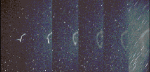 The Leonid Meteor Shower (Tonight)
16.11.1996
Tonight thousands of icy rocks will hurl toward Earth in a fascinating display of light called the Leonid Meteor Shower. There is little danger - few will reach the ground. But this year's Leonids could be nothing compared to the Leonids in 1998.
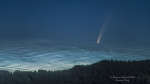 Noctilucent NEOWISE
9.07.2020
These silvery blue waves washing over a tree-lined horizon in the eastern French Alps are noctilucent clouds. From high in planet Earth's mesosphere, they reflect sunlight in this predawn skyscape taken on July 8. This summer, the night-shining clouds are not new to the northern high-latitudes. Comet NEOWISE is though.
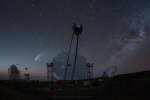 MAGIC NEOWISE
24.07.2020
The multi-mirror, 17 meter-diameter MAGIC telescopes reflect this starry night sky from the Roque de los Muchachos European Northern Observatory on the Canary Island of La Palma. MAGIC stands for Major Atmospheric Gamma Imaging...
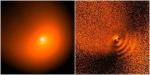 Hale-Bopp Polarized
25.04.1997
Light polarization is familiar to many outdoor enthusiasts who use polarizing sunglasses to cut the glare of reflected light. These two views of comet Hale-Bopp also demonstrate the effect of polarization. At left...
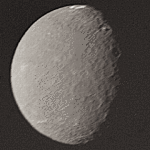 Uranus's Moon Umbriel: A Mysterious Dark World
7.04.1996
Why is Umbriel so dark? This dark moon reflects only half the light of other Uranus' moons such as Ariel. And what is that bright ring at the top? Unfortunately, nobody yet knows. These questions presented themselves when Voyager 2 passed this satellite of Uranus in January 1986.
 The Leonid Meteor Shower
16.11.1997
The Leonid Meteor Shower will likely reach its peak in the early hours this Monday morning. Though the Moon will be bright, Leo, the shower's radiant point, will be well above the eastern horizon from Western North America and the Pacific region during this period.
 A Leonid Meteor Explodes
18.11.2001
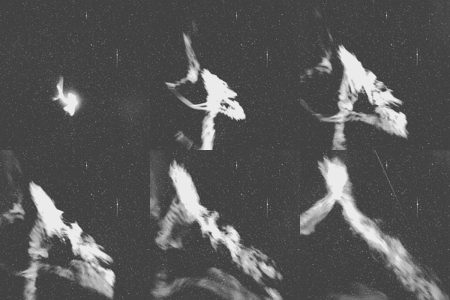
Last night and tonight, a lucky few may see a meteor explode. As our Earth passes unusually close to debris expelled from Comet Tempel-Tuttle, many sand-sized particles from this comet are entering and burning up in the Earth's atmosphere.
 Forty Thousand Meteor Origins Across the Sky
11.05.2009
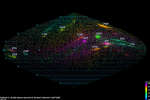
Where do meteors come from? Visible meteors are typically sand-sized grains of ice and rock that once fragmented from comets. Many a meteor shower has been associated with a known comet, although some intriguing orphan showers do remain.
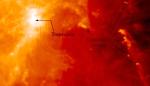 Cometary Globules In Orion
24.09.1999
Intense ultraviolet light from massive, hot stars in the Orion region has sculpted and compressed clouds of dust and gas in to distinctively shaped Cometary Globules. Seen in this IRAS infrared image recorded...
|
January February March April May June July August September |
|||||||||||||||||||||||||||||||||||||||||||||||||