
|
You entered: comet
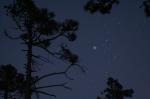 Forest and Sky
17.11.2007
With pine trees in dim silhouette, this skyscape from Breil-sur-Roya in southern France was captured on November 11. In the early evening scene, a satellite seems to streak through the branches, while bright, round, fuzzy Comet Holmes appears to lie just beyond them, near the stars of the constellation Perseus.
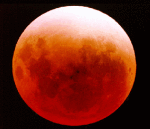 A Lucky Lunar Eclipse
3.04.1996
Tonight's full moon would normally washout the spectacle of Comet Hyakutake's lovely tail, even for those far from light polluted skies. Except that tonight comet observers are in luck - the dance of the planets calls for a total lunar eclipse! Lunar eclipses are caused when the Moon passes through the Earth's shadow.
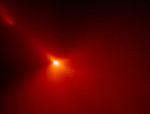 Near the Nucleus of Hyakutake
28.03.1996
NASA's Hubble Space Telescope captured this image of the near-nuclear region of Comet Hyakutake on March 25 as the comet approached within 9.3 million miles of the Earth. It covers a relatively "small" 2,000 mile wide area with the sunward direction toward the lower right (tailward is upper left).
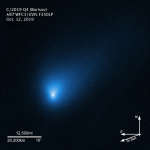 Interstellar Interloper 2I Borisov
18.10.2019
After the 2017 detecton of 1I/'Oumuamua, comet 2I/Borisov has become the second recognized interstellar interloper. Like 'Oumuamua, Borisov's measured hyperbolic trajectory and speed as it falls toward the Sun confirm that its origin is from beyond our Solar System.
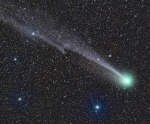 Long Lovejoy and Little Dumbbell
26.02.2015
Buffeted by the solar wind, Comet Lovejoy's crooked ion tail stretches over 3 degrees across this telescopic field of view, recorded on February 20. The starry background includes awesome bluish star Phi Persei below, and pretty planetary nebula M76 just above Lovejoy's long tail.
 Hale-Bopp on Schedule
25.07.1996
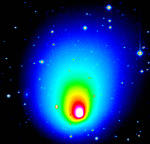
Late March and early April of 1996 marked a banner season for viewing the spectacular naked-eye comet Hyakutake. The spring of 1997 could well offer a similar cometary wonder, Comet Hale-Bopp. Discovered last year while approaching the inner solar sytem Hale-Bopp has been eagerly watched for signs that it will indeed brighten spectacularly.
 Meteors Now and Again
10.08.1998
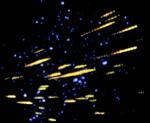
The Perseid Meteor Shower, usually the best meteor shower of the year, will peak over the next two nights. Over the course of an hour, a person watching a clear sky from a dark location might see as many as 100 meteors.
 Puzzling a Sky over Argentina
26.07.2016
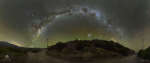
Can you find the comet? True, a careful eye can find thousands of stars, tens of constellations, four planets, three galaxies, and the central band of our Milky Way Galaxy -- all visible in the sky of this spectacular 180-degree panorama.
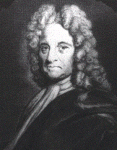 Edmund Halley's Greatest Discoveries
6.07.1996
Sir Edmond Halley was quite a discoverer. Born in 1656, he computed in 1705 that a bright comet was periodic and would make another appearance in 1758. The comet appeared as predicted and is now known as Comet Halley. Unfortunately, Halley died in 1742 and never saw his prediction come true.
 A Piece of Interplanetary Dust
13.08.2001
The dust that pervades our Solar System is not the dust that pervades our homes. Solar System dust comes from comets and asteroids, whereas house dust is most likely lint or dead cells. Pictured above is a piece of interplanetary dust caught by a high-flying U2-type aircraft.
|
January February March April May June July August |
||||||||||||||||||||||||||||||||||||||||||||||||||||||||