
|
You entered: distance
 Good Morning Planets from Chile
17.06.2022
On June 15, innermost planet Mercury had wandered about as far from the Sun as it ever gets in planet Earth's sky. Near the eastern horizon just before sunrise it stands over distant Andes mountain peaks in this predawn snapshot from the valley of Rio Hurtado in Chile.
 APOD: 2023 September 11 Б Beautiful Comet Nishimura
11.09.2023
This scene would be beautiful even without the comet. By itself, the sunrise sky is an elegant deep blue on high, with faint white stars peeking through, while near the horizon is a pleasing tan.
 APOD: 2024 March 5 Б NGC 2170: Angel Nebula Abstract Art
5.03.2024
Is this a painting or a photograph? In this celestial abstract art composed with a cosmic brush, dusty nebula NGC 2170, also known as the Angel Nebula, shines just above the image center. Reflecting...
 The Great Carina Nebula
19.04.2024
A jewel of the southern sky, the Great Carina Nebula is more modestly known as NGC 3372. One of our Galaxy's largest star forming regions, it spans over 300 light-years. Like the smaller, more northerly Great Orion Nebula, the Carina Nebula is easily visible to the unaided eye.
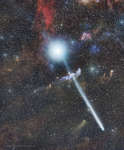 APOD: 2026 May 8 Б Comet R3 PanSTARRS Before Rigel
8.05.2026
Which way is Comet R3 PanSTARRS going? Not towards the star at the top of the image, because that is Rigel, which, being far in the background, is unrelated to the comet. Not through...
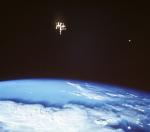 The Moons Of Earth
27.01.2001
While orbiting the planet during their June 1998 mission, the crew of the Space Shuttle Discovery photographed this view of two moons of Earth. Thick storm clouds are visible in the lovely blue planet...
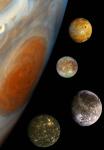 Jupiter And Family
29.09.1997
This composite image features classic portraits of members of one of the Solar System's most prominent families - Jupiter and its four large "Galilean" moons. Starting from the top the moons are Io, Europa, Ganymede, and Callisto. The top-to-bottom order is also the order of increasing distance from Jupiter.
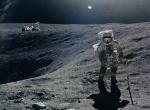 Apollo 16: Exploring Plum Crater
19.03.2000
Apollo 16 spent three days on Earth's Moon in April 1972. The fifth lunar landing mission out of six, Apollo 16 was famous for deploying and using an ultraviolet telescope as the first lunar observatory, and for collecting rocks and data on the mysterious lunar highlands. In the above picture, astronaut John W.
 NGC 7822 in Cepheus
28.08.2009
Pillars of gas, dust, and young, hot stars fill the center of NGC 7822. At the edge of a giant molecular cloud toward the northern constellation Cepheus, the glowing star forming region lies about 3,000 light-years away. Within the nebula, bright edges and tantalizing shapes are highlighted in this colorful skyscape.
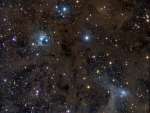 Stardust in Aries
25.11.2010
This composition in stardust covers almost 2 degrees on the sky, close to the border of the zodiacal constellation Aries and the plane of our Milky Way Galaxy. At the lower right...
|
January February March April May |
|||||||||||||||||||||||||||||||||||||||||||||||||