
|
You entered: stars
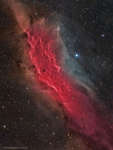 The California Nebula
12.01.2016
What's California doing in space? Drifting through the Orion Arm of the spiral Milky Way Galaxy, this cosmic cloud by chance echoes the outline of California on the west coast of the United States.
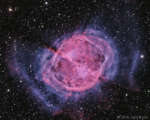 M27: The Dumbbell Nebula
2.11.2016
The first hint of what will become of our Sun was discovered inadvertently in 1764. At that time, Charles Messier was compiling a list of diffuse objects not to be confused with comets.
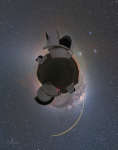 Little Planet to Exoplanets
14.09.2019
Of course this little planet is really planet Earth in a digitally stitched 360 x 180 degree mosaic captured high in the Chilean Atacama desert. The seemingly large domes house the 1-meter diameter telescopes of the SPECULOOS Southern Observatory.
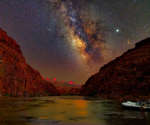 A Sunset Night Sky over the Grand Canyon
4.02.2020
Seeing mountain peaks glow red from inside the Grand Canyon was one of the most incredible sunset experiences of this amateur photographer's life. They appeared even more incredible later, when digitally combined with an exposure of the night sky -- taken by the same camera and from the same location -- an hour later.
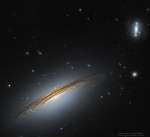 UGC 12591: The Fastest Rotating Galaxy Known
19.02.2020
Why does this galaxy spin so fast? To start, even identifying which type of galaxy UGC 12591 is difficult -- featured on the lower left, it has dark dust lanes like a spiral galaxy but a large diffuse bulge of stars like a lenticular.
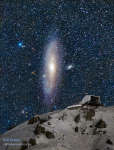 Andromeda Station
26.03.2020
This surreal picture isn't from a special effects sci-fi movie. It is a digital composite of frames of the real Andromeda Galaxy, also known as M31, rising over a real mountain. Exposures tracking the galaxy and background stars have been digitally combined with separate exposures of the foreground terrain.
 NGC 6995: The Bat Nebula
27.10.2021
Do you see the bat? It haunts this cosmic close-up of the eastern Veil Nebula. The Veil Nebula itself is a large supernova remnant, the expanding debris cloud from the death explosion of a massive star.
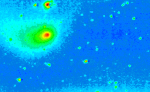 Comet Hale-Bopp Outbound
10.09.1997
Hale-Bopp, the Comet of the Century, is leaving the inner Solar System. Outbound at about 12 miles per second it is presently nearing the main asteroid belt between Mars and Jupiter. This false-color image represents a recent view from low Earth orbit showing the comet surrounded by its shrinking coma against a background of stars.
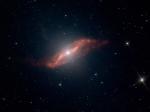 The Galaxy Within Centaurus A
4.03.2006
Peering deep inside Centaurus A, the closest active galaxy to Earth, the Spitzer Space Telescope's penetrating infrared cameras recorded this startling vista in February 2004. About 1,000 light-years across, the twisted cosmic...
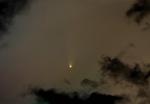 Comet McNaught Heads for the Sun
5.01.2007
Early morning risers with a clear and unobstructed eastern horizon can enjoy the sight of Comet McNaught (C/2006 P1) in dawn skies over the next few days. Discovered in August by R. H. McNaught...
|
January February March April May June July August September October |
|||||||||||||||||||||||||||||||||||||||||||||||||