
|
You entered: stars
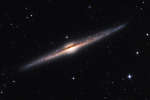 NGC 4565: Galaxy on the Edge
28.04.2009
Is our Galaxy this thin? We believe so. Magnificent spiral galaxy NGC 4565 is likely similar to our own spiral galaxy, but viewed edge-on from far away. Also known as the Needle Galaxy...
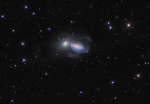 Arp 94
9.10.2013
This telescopic snapshot records a cosmic moment in the tumultuous lives of large spiral galaxy NGC 3227 and smaller elliptical NGC 3226. Catching them in the middle of an ongoing gravitational dance, the sensitive imaging also follows faint tidal star streams flung from the galaxies in their repeated close encounters.
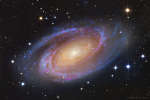 Bright Spiral Galaxy M81
18.11.2014
One of the brightest galaxies in planet Earth's sky is similar in size to our Milky Way Galaxy: big, beautiful M81. This grand spiral galaxy can be found toward the northern constellation of the Great Bear (Ursa Major).
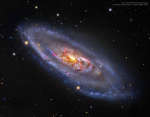 M106: A Spiral Galaxy with a Strange Center
17.03.2019
What's happening at the center of spiral galaxy M106? A swirling disk of stars and gas, M106's appearance is dominated by blue spiral arms and red dust lanes near the nucleus, as shown in the featured image.
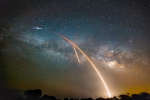 Milky Way, Launch, and Landing
11.05.2019
The Milky Way doesn't look quite this colorful and bright to the eye, but a rocket launch does. So a separate deep exposure with a sensitive digital camera was used in this composite skyscape to bring out our galaxy's central crowded starfields and cosmic dust clouds.
 M1: The Incredible Expanding Crab
15.11.2023
Cataloged as M1, the Crab Nebula is the first on Charles Messier's famous list of things which are not comets. In fact, the Crab Nebula is now known to be a supernova remnant, an expanding cloud of debris from the death explosion of a massive star.
 M1: The Incredible Expanding Crab
8.05.2025
Cataloged as M1, the Crab Nebula is the first on Charles Messier's famous list of things which are not comets. In fact, the Crab Nebula is now known to be a supernova remnant, an expanding cloud of debris from the death explosion of a massive star.
 APOD: 2025 May 20 Б Milky Way over Maunakea
20.05.2025
Have you ever seen the band of our Milky Way Galaxy? In a clear sky from a dark location at the right time, a faint band of light becomes visible across the sky. Soon after your eyes become dark adapted, you might spot the band for the first time. It may then become obvious.
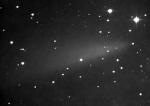 Comet LINEAR: Fade To Black
13.09.2000
Only last month the stage was set for Comet LINEAR (C/1999S4 LINEAR) to become the first "naked-eye" comet of Y2K. It didn't fill that role, of course, but it did turn in a very dramatic performance.
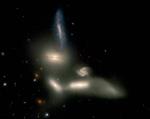 Seyfert's Sextet
24.01.2003
Known as Seyfert's Sextet, this intriguing group of galaxies lies in the head portion of the split constellation Serpens. The sextet actually contains only four interacting galaxies, though. Near the center of this...
|
January February March April May June July August September October |
|||||||||||||||||||||||||||||||||||||||||||||||||