
|
You entered: stars
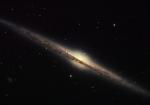 NGC 4565: Galaxy on the Edge
9.04.2004
Magnificent spiral galaxy NGC 4565 is viewed edge-on from planet Earth. Also known as the Needle Galaxy for its narrow profile, bright NGC 4565 is a stop on many springtime telescopic tours of the northern sky as it lies in the faint but well-groomed constellation Coma Berenices.
 M51: Cosmic Whirlpool
28.04.2005
Follow the handle of the Big Dipper away from the dipper's bowl, until you get to the handle's last bright star. Then, just slide your telescope a little south and west and you might find this stunning pair of interacting galaxies, the 51st entry in Charles Messier's famous catalog.
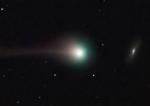 SWAN Meets Galaxy
19.10.2006
This cosmic portrait recorded October 9th features the lovely blue-green coma of Comet SWAN posing with spiral galaxy NGC 5005 in the northern constellation Canes Venatici. At the time the comet (center) was in the close foreground, a mere 9 light-minutes from planet Earth, with the galaxy a more substantial 60 million light-years distant.
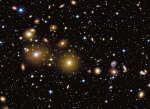 The Perseus Cluster of Galaxies
20.05.2008
Here is one of the largest objects that anyone will ever see on the sky. Each of these fuzzy blobs is a galaxy, together making up the Perseus Cluster, one of the closest clusters of galaxies. The cluster is seen through a foreground of faint stars in our own Milky Way Galaxy.
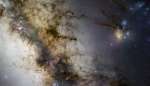 Gigagalaxy Zoom: Galactic Center
25.09.2009
From Sagittarius to Scorpius, the central Milky Way is a truly beautiful part of planet Earth's night sky. The gorgeous region is captured here, an expansive gigapixel mosaic of 52 fields spanning 34 by 20 degrees in 1200 individual images and 200 hours of exposure time.
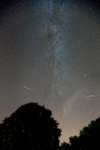 Night of the Perseids
14.08.2010
On the night of August 12, from moonset until dawn was a good time to see meteors. Enthusiasts watched as comet dust rained on planet Earth, streaking through dark skies during the annual Perseid Meteor Shower.
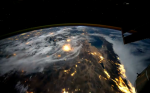 Flying over Planet Earth
27.09.2011
Have you ever dreamed of flying high above the Earth? Astronauts visiting the International Space Station do this every day, circling our restless planet twice every three hours. A dramatic example of their view was compiled in the above time-lapse video from images taken earlier this month.
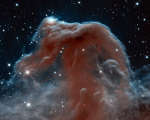 The Horsehead Nebula in Infrared from Hubble
22.04.2013
While drifting through the cosmos, a magnificent interstellar dust cloud became sculpted by stellar winds and radiation to assume a recognizable shape. Fittingly named the Horsehead Nebula, it is embedded in the vast and complex Orion Nebula (M42).
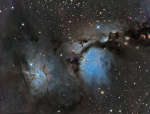 M78 and Reflecting Dust Clouds
26.03.2014
An eerie blue glow and ominous columns of dark dust highlight M78 and other bright reflection nebula in the constellation of Orion. The dark filamentary dust not only absorbs light, but also reflects the light of several bright blue stars that formed recently in the nebula.
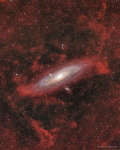 Clouds Around Galaxy Andromeda
24.10.2022
What are those red clouds surrounding the Andromeda galaxy? This galaxy, M31, is often imaged by planet Earth-based astronomers. As the nearest large spiral galaxy, it is a familiar sight with dark dust lanes, bright yellowish core, and spiral arms traced by clouds of bright blue stars.
|
January February March April May June July August September October |
|||||||||||||||||||||||||||||||||||||||||||||||||