
|
You entered: image
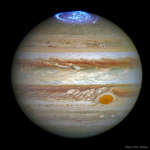 Aurorae on Jupiter
11.07.2016
Jupiter has aurorae. Like Earth, the magnetic field of the gas giant funnels charged particles released from the Sun onto the poles. As these particles strike the atmosphere, electrons are temporarily knocked away from existing gas molecules. Electric force attracts these electrons back. As the electrons recombine to remake neutral molecules, auroral light is emitted.
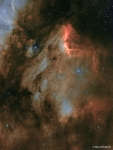 IC 5070: A Dusty Pelican in the Swan
19.11.2016
The recognizable profile of the Pelican Nebula soars nearly 2,000 light-years away in the high flying constellation Cygnus, the Swan. Also known as IC 5070, this interstellar cloud of gas and dust...
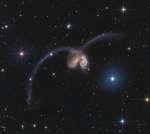 Exploring the Antennae
28.04.2017
Some 60 million light-years away in the southerly constellation Corvus, two large galaxies are colliding. Stars in the two galaxies, cataloged as NGC 4038 and NGC 4039, very rarely collide in the course of the ponderous cataclysm that lasts for hundreds of millions of years.
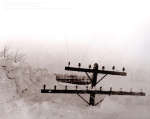 The Upper Michigan Blizzard of 1938
21.01.2018
Yes, but can your blizzard do this? In Upper Michigan's Storm of the Century in 1938, some snow drifts reached the level of utility poles. Nearly a meter of new and unexpected snow fell over two days in a storm that started 80 years ago this week.
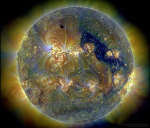 Venus and the Triply Ultraviolet Sun
4.02.2018
An unusual type of solar eclipse occurred in 2012. Usually it is the Earth's Moon that eclipses the Sun. That year, most unusually, the planet Venus took a turn. Like a solar eclipse by the Moon, the phase of Venus became a continually thinner crescent as Venus became increasingly better aligned with the Sun.
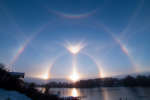 Extraordinary Solar Halos
21.12.2018
Welcome to the December Solstice, the first day of winter in planet Earth's northern hemisphere and summer in the south. To celebrate, consider this extraordinary display of beautiful solar ice halos! More common than rainbows, simple ice halos can be easy to spot, especially if you can shade your eyes from direct sunlight.
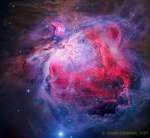 M42: Inside the Orion Nebula
30.10.2019
The Great Nebula in Orion, an immense, nearby starbirth region, is probably the most famous of all astronomical nebulas. Here, glowing gas surrounds hot young stars at the edge of an immense interstellar molecular cloud only 1500 light-years away.
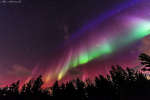 A Flag Shaped Aurora over Sweden
14.03.2021
It appeared, momentarily, like a 50-km tall banded flag. In mid-March of 2015, an energetic Coronal Mass Ejection directed toward a clear magnetic channel to Earth led to one of the more intense geomagnetic storms of recent years. A visual result was wide spread auroras being seen over many countries near Earth's magnetic poles.
 M16 Close Up
9.09.2021
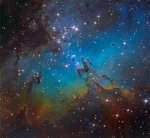
A star cluster around 2 million years young surrounded by natal clouds of dust and glowing gas, M16 is also known as The Eagle Nebula. This beautifully detailed image of the region adopts the colorful Hubble palette and includes cosmic sculptures made famous in Hubble Space Telescope close-ups of the starforming complex.
 The Full Moon of 2021
1.01.2022
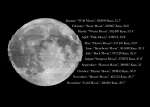
Every Full Moon of 2021 shines in this year-spanning astrophoto project, a composite portrait of the familiar lunar nearside at each brightest lunar phase. Arranged by moonth, the year progresses in stripes beginning at the top.
|
January February March April May June July August September |
|||||||||||||||||||||||||||||||||||||||||||||||||