
|
You entered: image
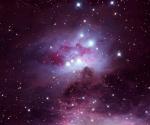 Reflections on the 1970s
2.10.2003
The 1970s are often overlooked. In particular, the beautiful grouping of reflection nebulae NGC 1977, NGC 1975, and NGC 1973 in Orion are often overlooked in favor of the substantial stellar nursery better known as the Orion Nebula.
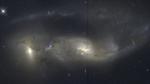 Arp 81: 100 Million Years Later
11.12.2003
From planet Earth, we view this strongly interacting pair of galaxies, cataloged as Arp 81, as they were only about 100 million years after their mutual closest approach. The havoc wreaked by gravity during...
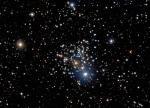 NGC 2266: Old Cluster in the New General Catalog
29.04.1999
The New General Catalog of star clusters and nebulae really isn't so new. In fact, it was published in 1888 - an attempt by J. L. E. Dreyer to consolidate the work of astronomers William, Caroline, and John Herschel along with others into a useful single, complete catalog of astronomical discoveries and measurements.
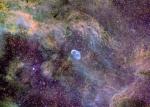 NGC 6888: A Tricolor Starfield
6.07.2006
NGC 6888, also known as the Crescent Nebula, is a cosmic bubble about 25 light-years across, blown by winds from its central, bright, massive star. Near the center of this intriguing widefield view of interstellar gas clouds and rich star fields of the constellation Cygnus, NGC 6888 is about 5,000 light-years away.
 NGC 1499: The California Nebula
24.09.2006
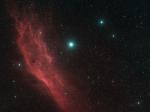
What's California doing in space? Drifting through the Orion Arm of the spiral Milky Way Galaxy, this cosmic cloud by chance echoes the outline of California on the west coast of the United States.
 The Horsehead Nebula
27.05.2007
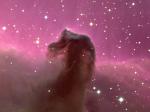
One of the most identifiable nebulae in the sky, the Horsehead Nebula in Orion, is part of a large, dark, molecular cloud. Also known as Barnard 33, the unusual shape was first discovered on a photographic plate in the late 1800s.
 Unusual Silica Rich Soil Discovered on Mars
18.12.2007
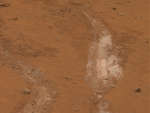
You're rolling across Mars when you unexpectedly uncover some unusually light soil. You stop. You turn. You return to inspect the soil and find out it is almost purely silica -- the main ingredient in quartz and glass. Such soil has never been found on Mars before. What created this soil?
 ISS: Sunlight to Shadow
28.02.2008
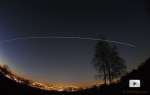
Orbiting 400,000 kilometers above the Earth, the Moon slid into Earth's shadow to begin last week's total lunar eclipse. Of course the International Space Station (ISS) slides into Earth's shadow every 90 minutes, the time it takes it to complete one orbit at an altitude of about 400 kilometers.
 Above Earth Fixing Hubble
20.05.2009
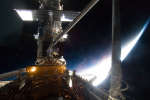
What is that astronaut doing? Fixing the Hubble Space Telescope. During the fourth servicing mission to upgrade and fix Hubble, astronaut Michael Good can be seen attached to the shuttle's robotic arm, working in an open panel of Hubble. Far below, the terminator between day and night can be seen across planet Earth.
 A Solar Prominence Erupts in STEREO
20.10.2009
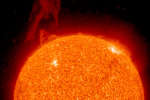
What does a solar prominence look like in three dimensions? To help find out, NASA launched the STEREO satellites to keep a steady eye on the Sun from two different vantage points. The STEREO...
|
January February March April May June July August September |
|||||||||||||||||||||||||||||||||||||||||||||||||