
|
You entered: image
 Ares 3 Landing Site: The Martian Revisited
17.05.2025
This close-up from the Mars Reconnaissance Orbiter's HiRISE camera shows weathered craters and windblown deposits in southern Acidalia Planitia. A striking shade of blue in standard HiRISE image colors, to the human eye the area would probably look grey or a little reddish.
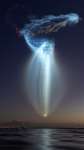 APOD: 2026 March 19 Б Launch Plume: SpaceX Jellyfish
19.03.2026
Even if you live with your head in the clouds, you wonБt find a jellyfish like this one very often. The featured image shows a SpaceX Falcon 9 rocket launch from Cape Canaveral in Florida on March 4.
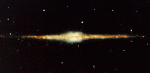 The Milky Way's Center
15.03.1997
Although the Earth is round, our Galaxy appears truly flat. This was shown in dramatic fashion by the COsmic Background Explorer (COBE) satellite which produced this premier view of the central region of our own Milky Way Galaxy in infrared light in1990.
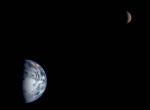 The Earth-Moon System
29.01.1998
This evocative mosaic image of the Earth-Moon system was recorded by NASA's Near Earth Asteroid Rendezvous (NEAR) spacecraft earlier this month. The relative sizes shown are appropriate for viewing both the Earth...
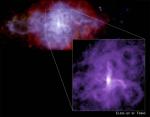 3C58: Pulsar Power
23.12.2004
Light from a star that exploded some ten thousand light-years away first reached our fair planet in the year 1181. Now known as supernova remnant 3C58, the region seen in this false-color image glows in x-rays, powered by a rapidly spinning neutron star or pulsar - the dense remains of the collapsed stellar core.
 NGC 3314: When Galaxies Overlap
11.05.2000
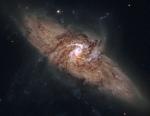
Can this be a spiral galaxy? In fact, NGC 3314 consists of two large spiral galaxies which just happen to almost exactly line-up. The foreground spiral is viewed nearly face-on, its pinwheel shape defined by young bright star clusters.
 A Large Tsunami Shock Wave on the Sun
13.12.2006
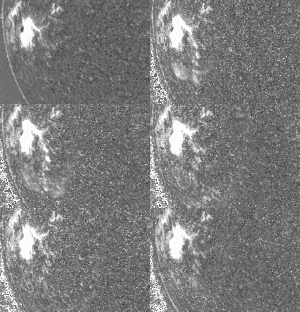
Tsunami's this large don't happen on Earth. One week ago, a large solar flare from an Earth-sized sunspot produced a tsunami-type shock wave that was spectacular even for the Sun. Pictured above...
 The Hercules Cluster of Galaxies
19.07.2007
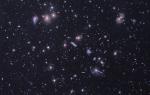
These are galaxies of the Hercules Cluster, an archipelago of island universes a mere 500 million light-years away. Also known as Abell 2151, this cluster is loaded with gas and dust rich, star-forming spiral galaxies but has relatively few elliptical galaxies, which lack gas and dust and the associated newborn stars.
 Shaping NGC 6188
2.05.2008
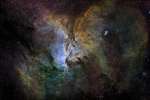
Dark shapes with bright edges winging their way through dusty NGC 6188 are tens of light-years long. The emission nebula is found near the edge of an otherwise dark large molecular cloud in the southern constellation Ara, about 4,000 light-years away.
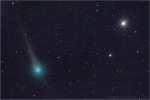 Lulin and Saturn near Opposition
27.02.2009
Tracking through the constellation Leo on February 23rd, bright planet Saturn and Comet Lulin were both near opposition -- opposite the Sun in planet Earth's sky. They also passed within only 2 degrees of each other creating a dramatic celestial photo-op.
|
January February March April May June July August September |
|||||||||||||||||||||||||||||||||||||||||||||||||