
|
You entered: image
 The Protoplanetary Disk of HL Tauri from ALMA
9.11.2014
Why does this giant disk have gaps? The exciting and probable answer is: planets. A mystery is how planets massive enough to create these gaps formed so quickly, since the HL Tauri star system is only about one million years old.
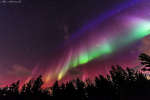 A Flag Shaped Aurora over Sweden
30.03.2015
It appeared, momentarily, like a 50-km tall banded flag. In mid-March, an energetic Coronal Mass Ejection directed toward a clear magnetic channel to Earth led to one of the more intense geomagnetic storms of recent years. A visual result was wide spread auroras being seen over many countries near Earth's magnetic poles.
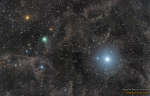 Polaris and Comet Lovejoy
2.06.2015
One of these two bright sky objects is moving. On the right is the famous star Polaris. Although only the 45th brightest star in the sky, Polaris is famous for appearing stationary. Once you find it, it will always appear in the same direction -- all night and all day -- for the rest of your life.
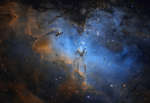 M16 and the Eagle Nebula
15.10.2015
A star cluster around 2 million years young surrounded by natal clouds of dust and glowing gas, M16 is also known as The Eagle Nebula. This beautifully detailed image of the region includes cosmic sculptures made famous in Hubble Space Telescope close-ups of the starforming complex.
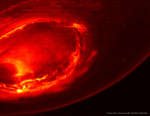 Aurora over Jupiters South Pole from Juno
6.12.2016
Why is there a glowing oval over Jupiter's South Pole? Aurora. Near the closest part of its first pass near Jupiter in August, NASA's robotic spacecraft Juno captured this dramatic infrared image of a bright auroral ring.
 NGC 7331 Close Up
7.02.2018
Big, beautiful spiral galaxy NGC 7331 is often touted as an analog to our own Milky Way. About 50 million light-years distant in the northern constellation Pegasus, NGC 7331 was recognized early on as a spiral nebula and is actually one of the brighter galaxies not included in Charles Messier's famous 18th century catalog.
 Lunations
12.09.2018
Our Moon's appearance changes nightly. As the Moon orbits the Earth, the half illuminated by the Sun first becomes increasingly visible, then decreasingly visible. The featured video animates images taken by NASA's Moon-orbiting Lunar Reconnaissance Orbiter to show all 12 lunations that appear this year, 2018.
 A Solar Filament Erupts
16.09.2018
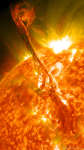
What's happened to our Sun? Nothing very unusual -- it just threw a filament. Toward the middle of 2012, a long standing solar filament suddenly erupted into space producing an energetic Coronal Mass Ejection (CME).
 NGC 1499: The California Nebula
23.08.2019
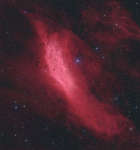
Drifting through the Orion Arm of the spiral Milky Way Galaxy, this cosmic cloud by chance echoes the outline of California on the west coast of the United States. Our own Sun also lies within the Milky Way's Orion Arm, only about 1,500 light-years from the California Nebula.
 A Mercury Transit Music Video from SDO
21.10.2019
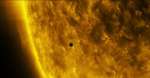
What's that small black dot moving across the Sun? Mercury. Possibly the clearest view of Mercury crossing in front of the Sun in 2016 May was from Earth orbit. The Solar Dynamics Observatory obtained an uninterrupted vista recording it not only in optical light but also in bands of ultraviolet light.
|
January February March April May June July August September |
|||||||||||||||||||||||||||||||||||||||||||||||||