
|
You entered: stars
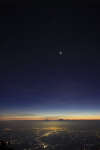 Four Planet Sunset
31.07.2010
This mesmerizing sunset photo was taken from the summit of volcanic Mount Lawu, 3,265 meters above sea level, on July 21. The view looks west, toward the city lights of Surakarta (aka Solo), Central Java, Indonesia. Two other volcanic peaks, sharp Merapi (left) and Merbabu lie along the colorful horizon.
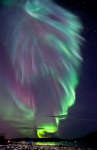 Aurora Over Norway
20.09.2010
Auroras can make spectacular sights. Photographed above last weekend, flowing multi-colored auroras helped illuminate a busy sky above TromsЬ, Norway. Besides the spectacular aurora pictured above, the photographer caught three satellites streaks, one airplane streak, and a friend trying to capture the same sight.
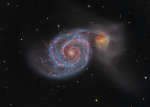 M51: The Whirlpool Galaxy
2.05.2015
Follow the handle of the Big Dipper away from the dipper's bowl until you get to the handle's last bright star. Then, just slide your telescope a little south and west and you might find this stunning pair of interacting galaxies, the 51st entry in Charles Messier famous catalog.
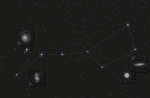 Big Dipper, Deep Sky
23.01.2016
The Big Dipper is an easy to recognize, well-known asterism in northern skies, though many see the Plough or Wagon. Famous bright nebulae of the north can also be found along its familiar lines, highlighted in this carefully composed scene with telescopic insets framed in the wider-field skyview.
 Centaurus A
9.03.2017
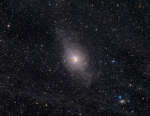
Only 11 million light-years away, Centaurus A is the closest active galaxy to planet Earth. Spanning over 60,000 light-years, the peculiar elliptical galaxy also known as NGC 5128, is featured in this sharp telescopic view.
 A Horizon with Blue and Red
5.12.2017
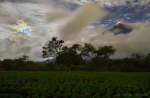
What's happening on the horizon? The horizon itself, past a spinach field in Guatemala, shows not only trees but a large volcano: the VolcАn de Fuego (Volcano of Fire). The red glow at the top of the volcano is hot lava.
 Aurora over Sweden
31.05.2020
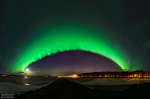
It was bright and green and stretched across the sky. This striking aurora display was captured in 2016 just outside of цstersund, Sweden. Six photographic fields were merged to create the featured panorama spanning almost 180 degrees. Particularly striking aspects of this aurora include its sweeping arc-like shape and its stark definition.
 Great Refractor and Lunar Eclipse
26.11.2021
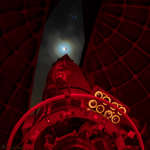
Rain clouds passed and the dome of the Lick Observatory's 36 inch Great Refractor opened on November 19. The historic telescope was pointed toward a partially eclipsed Moon. Illuminated by dim red lighting...
 Comet C 2023 E1 ATLAS near Perihelion
14.07.2023
Comet C/2023 E1 (ATLAS) was just spotted in March, another comet found by the NASA funded Asteroid Terrestrial-impact Last Alert System. On July 1 this Comet ATLAS reached perihelion, its closest approach to the Sun.
 APOD: 2023 July 16 Б Meteor and Milky Way over the Alps
16.07.2023
Now this was a view with a thrill. From Mount Tschirgant in the Alps, you can see not only nearby towns and distant Tyrolean peaks, but also, weather permitting, stars, nebulas, and the band of the Milky Way Galaxy.
|
January February March April May June July August September October |
|||||||||||||||||||||||||||||||||||||||||||||||||