
|
You entered: orbit
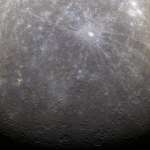 MESSENGER at Mercury
31.03.2011
On March 17, the MESSENGER spacecraft became the first to orbit Mercury, the solar system's innermost planet. This is its first processed color image since entering Mercury orbit. Larger, denser, and with almost twice the surface gravity of Earth's moon, Mercury still looks moon-like at first glance.
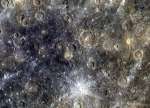 Mercury's Surface in Exaggerated Color
16.06.2011
The robotic MESSENGER spacecraft recently completed over 100 orbits of Mercury. Messenger's cameras have recorded detailed pictures utilizing eight different colors across visible and near infrared light, exploring the surface composition and looking for clues to the history and evolution of the solar system's innermost planet.
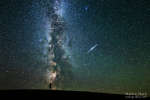 The Flare and the Galaxy
2.09.2015
Is this person throwing a lightning bolt? No. Despite appearances, this person is actually pointing in the direction of a bright Iridium flare, a momentary reflection of sunlight off of a communications satellite in orbit around the Earth.
 Stereo Helene
1.06.2024
Get out your red/blue glasses and float next to Helene, small, icy moon of Saturn. Appropriately named, Helene is a Trojan moon, so called because it orbits at a Lagrange point. A Lagrange point is a gravitationally stable position near two massive bodies, in this case Saturn and larger moon Dione.
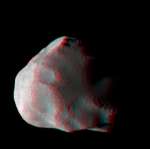 Stereo Helene
29.03.2025
Get out your red/blue glasses and float next to Helene, small, icy moon of Saturn. Appropriately named, Helene is a Trojan moon, so called because it orbits at a Lagrange point. A Lagrange point is a gravitationally stable position near two massive bodies, in this case Saturn and larger moon Dione.
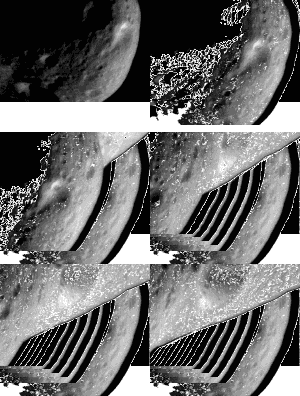 Flying Over Asteroid Eros West End
17.04.2000
The robot spacecraft NEAR Shoemaker continues to orbit asteroid Eros. This condensed 40-minute long time-lapse sequence taken last month shows what it looks like to pass within 200 kilometers of Eros' west end. The north pole of the rotating mountain is toward the bottom of the picture.
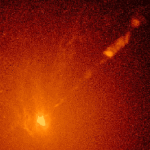 A Black Hole in M87's Center?
5.03.1996
The center of nearby giant galaxy M87 is a dense and violent place. In this 1994 photograph by the Hubble Space Telescope, a disk of hot gas was found to be orbiting at the center of this massive elliptical galaxy. The disk is evident on the lower left of the above photograph.
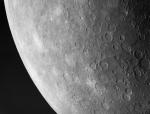 Southwest Mercury
16.02.2003
The planet Mercury resembles a moon. Mercury's old surface is heavily cratered like many moons. Mercury is larger than most moons but smaller than Jupiter's moon Ganymede and Saturn's moon Titan. Mercury is much denser and more massive than any moon, though, because it is made mostly of iron.
 APOD: 2024 August 11 Б Animation: Perseid Meteor Shower
11.08.2024
Where do Perseid meteors come from? Mostly small bits of stony grit, Perseid meteoroids were once expelled from Comet Swift-Tuttle and continue to follow this comet's orbit as they slowly disperse. The featured animation depicts the entire meteoroid stream as it orbits our Sun.
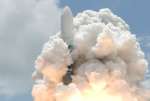 At Last, GLAST
13.06.2008
Rising through a billowing cloud of smoke, this Delta II rocket left Cape Canaveral Air Force Station's launch pad 17-B Wednesday at 12:05 pm EDT. Snug in the payload section was GLAST, the Gamma-ray Large Area Space Telescope, now in orbit around planet Earth.
|
January February March April May June July August September |
|||||||||||||||||||||||||||||||||||||||||||||||||