
|
You entered: orbit
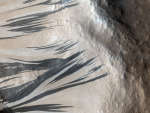 Slope Streaks in Acheron Fossae on Mars
28.02.2010
What creates these picturesque dark streaks on Mars? No one knows for sure. A leading hypothesis is that streaks like these are caused by fine grained sand sliding down the banks of troughs and craters. Pictured above, dark sand appears to have flowed hundreds of meters down the slopes of Acheron Fossae.
 APOD: 2025 May 25 Б Beneath Jupiter
24.05.2025
Jupiter is stranger than we knew. NASA's Juno spacecraft has now completed over 70 swoops past Jupiter as it moves around its highly elliptical orbit. Pictured from 2017, Jupiter is seen from below where, surprisingly, the horizontal bands that cover most of the planet disappear into swirls and complex patterns.
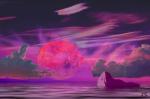 Sunrise from the Surface of Gliese 581c
2.05.2007
How might a sunrise appear on Gliese 581c? One artistic guess is shown above. Gliese 581c is the most Earth-like planet yet discovered and lies a mere 20 light-years distant. The central red dwarf...
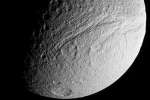 Ithaca Chasma: The Great Rift on Saturns Tethys
24.06.2008
What created the Great Rift on Saturn's moon Tethys? No one is sure. More formally named Ithaca Chasma, the long canyon running across the right of the above image extends about 2,000 kilometers long and spreads as much as 100 kilometers wide.
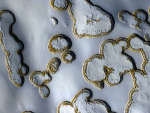 Dry Ice Pits on Mars
26.09.2011
Part of Mars is defrosting. Around the South Pole of Mars, toward the end of every Martian summer, the warm weather causes a section of the vast carbon-dioxide ice cap to evaporate. Pits begin to appear and expand where the carbon dioxide dry ice sublimates directly into gas.
 Curiosity Drops In
8.08.2012
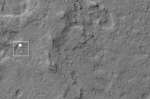
Just as it captured the Phoenix lander parachuting to Mars in 2008, the HiRise camera onboard the Mars Reconnaissance Orbiter (MRO) snapped this picture of the Curiosity rover's spectacular descent toward its landing site on August 5 (PDT).
 Phobos: Doomed Moon of Mars
2.07.2022
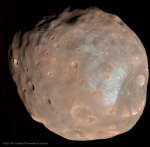
This moon is doomed. Mars, the red planet named for the Roman god of war, has two tiny moons, Phobos and Deimos, whose names are derived from the Greek for Fear and Panic. These...
 The First Explorer
31.01.2008
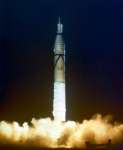
Fifty years ago (on January 31, 1958) the First Explorer, was launched into Earth orbit by the Army Ballistic Missile Agency. Inaugurating the era of space exploration for the United States, Explorer I was a thirty pound satellite that carried instruments to measure temperatures, and micrometeorite impacts, along with an experiment designed by James A.
 Manicouagan Impact Crater from Space
1.05.2019
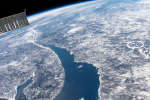
Orbiting 400 kilometers above Quebec, Canada, planet Earth, the International Space Station Expedition 59 crew captured this snapshot of the broad St. Lawrence River and curiously circular Lake Manicouagan on April 11. Right of center, the ring-shaped lake is a modern reservoir within the eroded remnant of an ancient 100 kilometer diameter impact crater.
 NICER at Night
31.05.2019
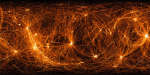
A payload on board the International Space Station, the Neutron star Interior Composition Explorer (NICER) twists and turns to track cosmic sources of X-rays as the station orbits planet Earth every 93 minutes. During orbit nighttime, its X-ray detectors remain on.
|
January February March April May June July August September |
|||||||||||||||||||||||||||||||||||||||||||||||||