
|
You entered: orbit
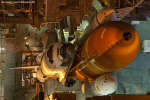 Endeavour Looking Up
2.04.2011
First flown in 1992, Endeavour, the youngest space shuttle orbiter, is being prepared for its 25th and final trip to low Earth orbit. Seen here from an exciting perspective 400 feet above the floor...
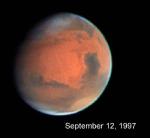 A Martian Autumn Begins
23.09.1997
Today is the first day of Autumn in the Northern Hemisphere of Planet Earth. The Autumnal Equinox occured yesterday at 7:56 pm EDT as the Sun crossed the celestial equator from North to South.
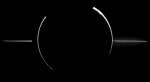 Jupiters Rings Revealed
5.01.2008
Why does Jupiter have rings? Jupiter's rings were discovered in 1979 by the passing Voyager 1 spacecraft, but their origin was a mystery. Data from the Galileo spacecraft that orbited Jupiter from 1995 to 2003 later confirmed that these rings were created by meteoroid impacts on small nearby moons.
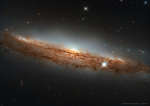 NGC 3717: A Nearly Sideways Spiral Galaxy
11.11.2019
Some spiral galaxies are seen nearly sideways. Most bright stars in spiral galaxies swirl around the center in a disk, and seen from the side, this disk can be appear quite thin. Some spiral galaxies appear even thinner than NGC 3717, which is actually seen tilted just a bit.
 APOD: 2025 April 8 Б Moon Visits Sister Stars
7.04.2025
Sometimes, the Moon visits the Pleiades. Technically, this means that the orbit of our Moon takes it directly in front of the famous Pleiades star cluster, which is far in the distance. The technical...
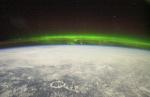 Aurora from Space
8.04.2003
What do auroras look like from space? From the ground, auroras dance high above clouds, frequently causing spectacular displays. The International Space Station (ISS) orbits just at the same height as many auroras, though. Therefore, sometimes it flies over them, but also sometimes it flies right through.
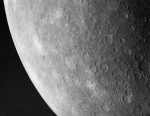 Southwest Mercury
13.09.1996
The planet Mercury resembles a moon. Mercury's old surface is heavily cratered like many moons. Mercury is larger than most moons but smaller than Jupiter's moon Ganymede and Saturn's moon Titan. Mercury is much denser and more massive than any moon, though, because it is made mostly of iron.
 APOD: 2025 July 7 Б Interstellar Comet 3I ATLAS
6.07.2025
It came from outer space. An object from outside our Solar System is now passing through at high speed. Classified as a comet because of its gaseous coma, 3I/ATLAS is only the third identified macroscopic object as being so alien.
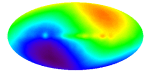 COBE Dipole: Speeding Through the Universe
4.02.1996
Our Earth is not at rest. The Earth moves around the Sun. The Sun orbits the center of the Milky Way Galaxy. The Milky Way Galaxy orbits in the Local Group. The Local Group falls toward the Virgo Cluster of Galaxies.
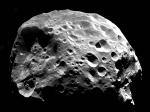 Phoebe: Comet Moon of Saturn
11.02.2006
Was Saturn's moon Phoebe once a comet? Images from the robotic Cassini spacecraft taken two years ago when entering the neighborhood of Saturn indicate that Phoebe may have originated in the outer Solar System.
|
January February March April May June July August September |
|||||||||||||||||||||||||||||||||||||||||||||||||