
|
You entered: light
 Galaxy Cove Vista Revisited
29.06.2014
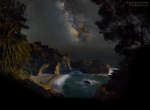
To see a vista like this takes patience, hiking, and a camera. Patience was needed in searching out just the right place and waiting for just the right time. A short hike was needed to reach this rugged perch above a secluded cove in Julia Pfeiffer Burns State Park in California, USA.
 Ultima Thule Rotation Gif
3.01.2019
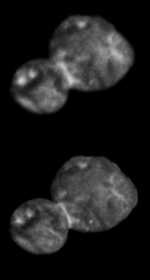
Ultima Thule is the most distant world explored by a spacecraft from Earth. In the dim light 6.5 billion kilometers from the Sun, the New Horizons spacecraft captured these two frames 38 minutes apart as it sped toward the Kuiper belt world on January 1 at 51,000 kilometers per hour.
 Long Tailed Comet SWAN
7.05.2020
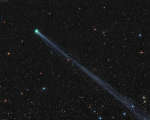
Blowing in the solar wind the spectacular ion tail of Comet SWAN (C/2020 F8) extends far across this 10 degree wide telephoto field of view. Captured on May 2 its greenish coma was about 6 light-minutes from Earth. The pretty background starfield lies near the border of the constellations Cetus and Aquarius.
 The Surface of Titan
20.08.2000
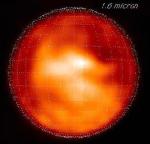
If sailing the hydrocarbon seas of Titan, beware of gasoline rain. Such might be a travel advisory issued one future day for adventurers visiting Titan, the largest moon of Saturn. New images of Titan's surface were released last week from the Canada-France Hawaii Telescope featuring the finest details yet resolved.
 Sagittarius and the Central Milky Way
5.06.1996
What does the center of our Milky Way Galaxy look like? No one knows! It is not possible to see the Galactic center in light our eyes are sensitive to because the thick dust in the plane of our Galaxy obscures it.
 The Milky Way Over Mount Blanc
23.09.2002
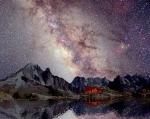
Have you ever seen the band of our Milky Way Galaxy? Chances are you have never seen it like this -- nor could you. In a clear sky from a dark location at the right time, a faint band of light is visible across the sky. This band is the disk of our spiral galaxy.
 Orions Horsehead Nebula
28.01.2003
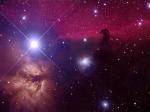
The Horsehead Nebula is one of the most famous nebulae on the sky. It is visible as the dark indentation to the red emission nebula seen above and to the right of center in the above photograph. The bright star on the left is located in the belt of the familiar constellation of Orion.
 A Quasar in the Gamma Ray Sky
16.11.1996
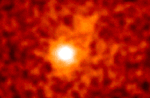
The bright object in the center of the false color image above is quasar 3C279 viewed in gamma-rays, photons with more than 40 million times the energy of visible light. Like all quasars, 3C279 is a nondescript, faint, starlike object in the visible sky.
 Fliers Around the Blue Snowball Nebula
21.11.1996
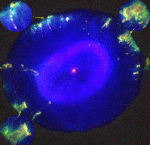
Planetary nebulae are strange. First, they are gas clouds and have nothing to do with our Solar System's planets. Next, although hundreds of planetary nebulae have been catalogued and thousands surely exist in our Galaxy, aspects of the formation process are still debated.
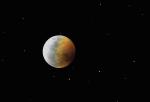 Eclipsed Moon and Stars
23.05.2003
Half-shadowed by the Earth, the Moon takes on a remarkable appearance against a field of stars in this intriguing telephoto picture recorded during a partial phase of last week's lunar eclipse. The picture is not a composite, but it has been digitally enhanced to bring out features covering a large range in brightness.
|
January February |
|||||||||||||||||||||||||||||||||||||||||||||||||