
|
You entered: light
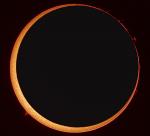 An Annular Solar Eclipse at High Resolution
5.10.2005
On Monday, part of the Sun went missing. The missing piece was no cause for concern -- the Moon was only momentarily in the way. The event was not a total eclipse of the Sun for any Earth-bound sky enthusiast but rather, at best, an annular eclipse, where the Moon blocked most of the Sun.
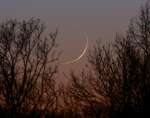 A Twilight Occultation
10.12.2010
A thin, one day old crescent Moon hugged the western horizon after sunset on Monday, December 6. The Moon also occulted or passed in front of Mars. But only some well-placed skygazers along a band through North America were able to catch this lunar occultation's final act in fading twilight.
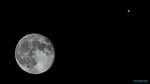 Moons and Jupiter
3.03.2016
Some of the Solar System's largest moons rose together on February 23. On that night, a twilight pairing of a waning gibbous Moon and Jupiter was captured in this sharp telescopic field of view.
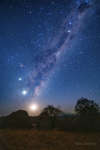 Moon, Four Planets, and Emu
8.02.2019
A luminous Milky Way falls toward the horizon in this deep skyscape, starting at the top of the frame from the stars of the Southern Cross and the dark Coalsack Nebula. Captured...
 Reflecting the International Space Station
28.05.2020
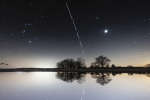
Still bathed in sunlight, the International Space Station arced through the evening sky over lake Wulfsahl-Gusborn in northern Germany, just after sunset on March 25. The familiar constellation of Orion can be seen left of the trail of the orbital station's bright passage.
 The Fornax Cluster of Galaxies
29.01.2022
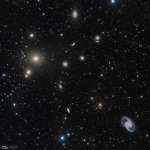
Named for the southern constellation toward which most of its galaxies can be found, the Fornax Cluster is one of the closest clusters of galaxies. About 62 million light-years away, it is almost...
 Epsilon Tauri: Star with Planet
26.01.2024
Epsilon Tauri lies 146 light-years away. A K-type red giant star, epsilon Tau is cooler than the Sun, but with about 13 times the solar radius it has nearly 100 times the solar luminosity.
 Jupiter, Europa, and Callisto
2.01.2001
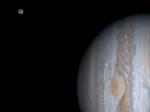
As the robot Cassini spacecraft rounds Jupiter on its way toward Saturn, it has taken a sequence of images of the gas giant with its four largest moons. Previously released images have highlighted Ganymede and Io. Pictured above are the two remaining Galilean satellites: Europa and Callisto.
 A Newly Active Volcano On Jupiters Io
16.10.2001
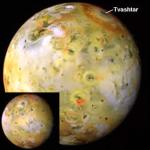
Would a volcano plume discovered in January above Jupiter's Moon Io still be active months later? To answer this question, the robot spacecraft Galileo currently in orbit around Jupiter was maneuvered to image the plume site during its recent flyby of Io in August.
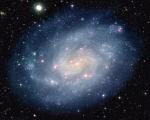 Spiral Galaxy NGC 300
21.08.2002
NGC 300 is so interesting because it is so normal. An Sc-type spiral galaxy in the nearby Sculptor group of galaxies, NGC 300 shows typical flowing blue spiral arms, an expected compact nucleus, and the requisite amount of stars, star clusters, and nebulae.
|
January February |
|||||||||||||||||||||||||||||||||||||||||||||||||