
|
You entered: light
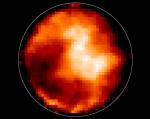 The Surface of Titan
4.08.1999
If sailing the hydrocarbon seas of Titan, beware of gasoline rain. Such might be a travel advisory issued next millennium for adventurers visiting Titan, the largest moon of Saturn. Images of Titan's surface were released last week from the Keck 10-meter telescope featuring the finest details yet resolved.
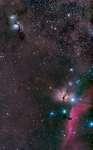 Orion s Belt Continued
10.02.2009
Yesterday's skyscape featured Alnitak, Alnilam, and Mintaka, the stars of Orion's Belt. Today's also presents the easternmost belt star, Alnitak, at the bottom right of the field, surrounded by the well-known Horsehead and Flame nebulae.
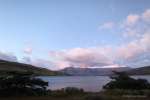 Moonbow and Rainbows Over Patagonia
10.08.2009
Have you ever seen a moonbow? Just as rainbows are lit by the Sun, moonbows are lit by the Moon. Since the Sun is so much brighter than the Moon, sunlit rainbows are much brighter and more commonly seen than moonbows.
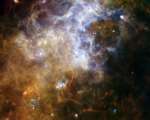 Herschel Views the Milky Way
2.09.2011
With a 3.5 meter diameter mirror, larger than the Hubble Space Telescope, ESA's Herschel Space Observatory explores the Universe at infrared wavelengths. Herschel is named for German-born British astronomer Frederick William Herschel who discovered infrared light over 200 years ago.
 Comet Between Fireworks and Lightning
10.11.2013
Sometimes the sky itself is the best show in town. In January 2007, people from Perth, Australia gathered on a local beach to watch a sky light up with delights near and far. Nearby, fireworks exploded as part of Australia Day celebrations. On the far right, lightning from a thunderstorm flashed in the distance.
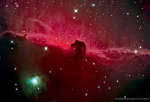 The Horsehead Nebula
31.12.2013
The Horsehead Nebula is one of the most famous nebulae on the sky. It is visible as the dark indentation to the red emission nebula in the center of the above photograph. The horse-head feature is dark because it is really an opaque dust cloud that lies in front of the bright red emission nebula.
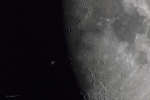 Space Station over Lunar Terminator
26.04.2015
What's that in front of the Moon? It's the International Space Station. Using precise timing, the Earth-orbiting space platform was photographed in front of a partially lit Moon last year. The featured image was taken from Madrid, Spain with an exposure time of only 1/1000 of a second.
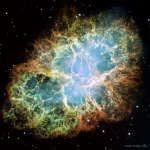 M1: The Crab Nebula from Hubble
15.08.2015
This is the mess that is left when a star explodes. The Crab Nebula, the result of a supernova seen in mysterious filaments. The filaments are not only tremendously complex, but appear to have less mass than expelled in the original supernova and a higher speed than expected from a free explosion.
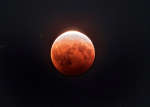 Total Lunar Eclipse from Sydney
27.05.2021
The reddened shadow of planet Earth plays across the lunar disk in this telescopic image taken on May 26 near Sydney, New South Wales, Australia. On that crisp, clear autumn night a Perigee Full Moon slid through the northern edge of the shadow's dark central umbra.
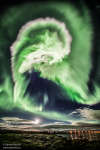 A Spiral Aurora over Iceland
11.09.2021
What's happened to the sky? Aurora! Captured in 2015, this aurora was noted by Icelanders for its great brightness and quick development. The aurora resulted from a solar storm, with high energy particles bursting out from the Sun and through a crack in Earth's protective magnetosphere a few days later.
|
January February |
|||||||||||||||||||||||||||||||||||||||||||||||||