
|
You entered: image
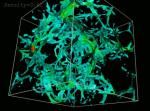 The Lyman Alpha Forest
12.11.2000
We live in a forest. Strewn throughout the universe are "trees" of hydrogen gas that absorb light from distant objects. These gas clouds leave numerous absorption lines in a distant quasar's spectra, together called the Lyman-alpha forest.
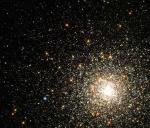 M80: A Dense Globular Cluster
7.07.1999
If our Sun were part of M80, the night sky would glow like a jewel box of bright stars. M80, also known as NGC 6093, is one of about 250 globular clusters that survive in our Galaxy.
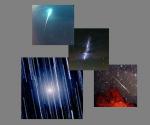 Leonid Watching
16.11.2001
Will the Leonids storm this year? The annual Leonid meteor shower should peak this weekend and some predictions suggest that "storm" rates of a thousand or more meteors per hour are possible for observers located in eastern North and Central America during the early morning hours of Sunday, November 18.
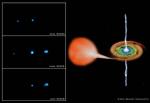 The X Ray Jets of XTE J1550
8.10.2002
The motion of ultra-fast jets shooting out from a candidate black hole star system have now been documented by observations from the orbiting Chandra X-ray Observatory. In 1998, X-ray source XTE J1550-564 underwent a tremendous outburst.
 Radio Jupiter
9.10.2003
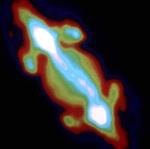
This view of gas giant Jupiter, made from data recorded at the Very Large Array radio observatory near Socorro, New Mexico, may not look too familiar. In fact, there is no sign of a bright, round planet striped with cloud bands, sporting a Great Red Spot.
 A Planet Transits the Sun
8.06.2004
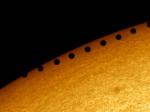
Today an astronomical event will occur that no living person has ever seen: Venus will cross directly in front of the Sun. A Venus crossing, called a transit, last occurred in 1882 and was front-page news around the world.
 Solar System Rising Over Fire Island
3.05.2005
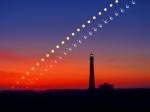
If you wait long enough, the entire Solar System will rise before you. To see such a sight, however, you will need to look in the direction of the ecliptic. All of the planets and their moons orbit the Sun in nearly the same plane, the ecliptic plane.
 Venus: Just Passing By
12.06.1999
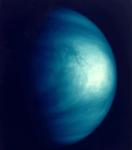
Venus, the second closest planet to the Sun, is a popular way-point for spacecraft headed for the gas giant planets in the outer reaches of the solar system. Why visit Venus first? Using...
 The Averted Side Of The Moon
7.10.1999
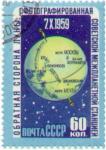
This vintage 60-kopek stamp celebrates a dramatic achievement. On October 7th, forty years ago (7/X/1959), the Soviet interplanetary station which has come to be called "Luna 3" successfully photographed the far side of the moon giving denizens of planet Earth their first ever view of this hidden hemisphere.
 NGC 602 and Beyond
10.01.2007
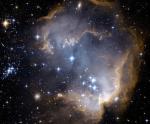
Near the outskirts of the Small Magellanic Cloud, a satellite galaxy some 200 thousand light-years distant, lies 5 million year young star cluster NGC 602. Surrounded by natal gas and dust, NGC 602 is featured in this stunning Hubble image of the region.
|
January February March April May June July August September |
|||||||||||||||||||||||||||||||||||||||||||||||||