
|
You entered: image
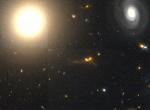 Elliptical Galaxy NGC 4881 in Coma
21.11.1999
Elliptical galaxies are unlike spiral galaxies and hence unlike our own Milky Way Galaxy. The giant elliptical galaxy named NGC 4881 on the upper left lies at the edge of the giant Coma Cluster of Galaxies.
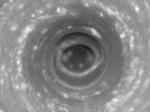 A Hurricane Over the South Pole of Saturn
13.11.2006
What's happening at the south pole of Saturn? To find out, scientists sent the robot Cassini probe now orbiting Saturn directly over the lower spin axis of the ringed giant. Cassini found there a spectacular massive swirling storm system with a well developed eye-wall, similar to a hurricane here on Earth.
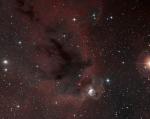 LDN 1622: Dark Nebula in Orion
11.05.2007
The silhouette of an intriguing dark nebula inhabits this cosmic scene, based on images from the Palomar Observatory Sky Survey. Lynds' Dark Nebula (LDN) 1622 appears against a faint background of glowing hydrogen gas only easily seen in long telescopic exposures of the region.
 Circum axial Leaf Trails
19.05.2007
Are photographs of star trails really evidence of the Earth's rotation about its axis? Yes they are, and science journalist Trudy E. Bell discovered that there is a simple way to demonstrate this, if you have the stomach for it.
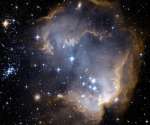 NGC 602 and Beyond
25.10.2008
Near the outskirts of the Small Magellanic Cloud, a satellite galaxy some 200 thousand light-years distant, lies 5 million year young star cluster NGC 602. Surrounded by natal gas and dust, NGC 602 is featured in this stunning Hubble image of the region.
 Sunset at the Portara
20.03.2009
Today, the Sun crosses the celestial equator heading north at 11:44 UT. Known as an equinox, this astronomical event marks the first day of spring in the northern hemisphere and autumn in the south. It also marks the beginning of Norouz, the Persian (Iranian) new year. Equinox means equal night.
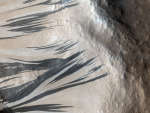 Slope Streaks in Acheron Fossae on Mars
1.03.2010
What creates these picturesque dark streaks on Mars? No one knows for sure. A leading hypothesis is that streaks like these are caused by fine grained sand sliding down the banks of troughs and craters. Pictured above, dark sand appears to have flowed hundreds of meters down the slopes of Acheron Fossae.
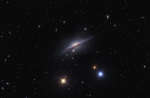 NGC 1055: Galaxy in a Box
24.04.2010
Big, beautiful spiral galaxy NGC 1055 is a dominant member of a small galaxy group a mere 60 million light-years away toward the intimidating constellation Cetus. Seen edge-on, the island universe spans about 100,000 light-years, similar in size to our own Milky Way.
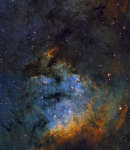 NGC 7822 in Cepheus
22.10.2010
Pillars of gas, dust, and young, hot stars seem to fill the gaping maw of NGC 7822. At the edge of a giant molecular cloud toward the northern constellation Cepheus, the glowing star forming region lies about 3,000 light-years away. Within the nebula, bright edges and dark shapes are highlighted in this colorful skyscape.
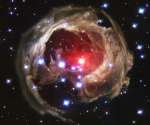 Light Echoes from V838 Mon
4.12.2011
For reasons unknown, star V838 Mon's outer surface suddenly greatly expanded with the result that it became the brightest star in the entire Milky Way Galaxy in January 2002. Then, just as suddenly, it faded. A stellar flash like this has never been seen before.
|
January February March April May June July August September |
|||||||||||||||||||||||||||||||||||||||||||||||||