
|
You entered: image
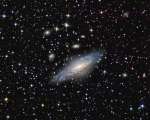 NGC 7331 and Beyond
12.07.2008
Big, beautiful spiral galaxy NGC 7331 is often touted as an analog to our own Milky Way. About 50 million light-years distant in the northern constellation Pegasus, NGC 7331 was recognized early on as a spiral nebula and is actually one of the brighter galaxies not included in Charles Messier's famous 18th century catalog.
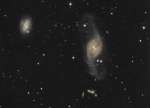 Extra Galaxies
17.07.2008
(xxxedit and linkxxx) A careful look at the full field of view for this sharp image reveals a surprising number of galaxies both near and far toward the constellation Ursa Major. The most striking is clearly NGC 3718, the warped spiral galaxy right of center.
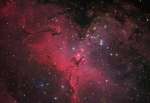 M16 and the Eagle Nebula
19.07.2008
Young star cluster M16 is surrounded by natal clouds of cosmic dust and glowing gas also known as The Eagle Nebula. This beautifully detailed image of the region includes fantastic shapes made famous in well-known Hubble Space Telescope close-ups of the starforming complex.
 NGC 7822 in Cepheus
28.08.2009
Pillars of gas, dust, and young, hot stars fill the center of NGC 7822. At the edge of a giant molecular cloud toward the northern constellation Cepheus, the glowing star forming region lies about 3,000 light-years away. Within the nebula, bright edges and tantalizing shapes are highlighted in this colorful skyscape.
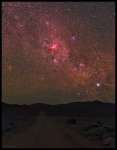 On the Road to Carina
18.02.2012
This rugged road through the dark Atacama Desert seems to lead skyward toward the bright stars and glowing nebulae of the southern Milky Way. If you follow the road you will get to Cerro Armazones peak in Chile, future construction site for the 40-meter class European Extremely Large Telescope.
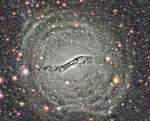 The Outer Shells of Centaurus A
1.07.2012
What causes the surrounding shells in peculiar galaxy Cen A? In 2002 a fascinating image of peculiar galaxy Centaurus A was released, processed to highlight a faint blue arc indicating an ongoing collision with a smaller galaxy.
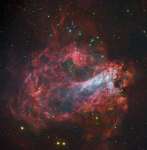 Star Factory Messier 17
18.04.2013
Sculpted by stellar winds and radiation, the star factory known as Messier 17 lies some 5,500 light-years away in the nebula-rich constellation Sagittarius. At that distance, this degree wide field of view spans almost 100 light-years.
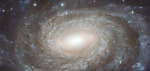 NGC 6384: Spiral Beyond the Stars
6.07.2013
The universe is filled with galaxies. But to see them astronomers must look out beyond the stars of our own galaxy, the Milky Way. This colorful Hubble Space Telescopic portrait features spiral galaxy NGC 6384, about 80 million light-years away in the direction of the constellation Ophiuchus.
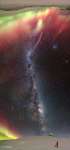 Milky Way and Aurora over Antarctica
27.07.2015
It has been one of the better skies of this long night. In parts of Antarctica, not only is it winter, but the Sun can spend weeks below the horizon. At China's Zhongshan Station, people sometimes venture out into the cold to photograph a spectacular night sky.
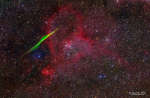 Spiral Meteor through the Heart Nebula
5.09.2016
What is this meteor doing? Dynamically, the unusually short and asymmetric train may indicate that the sand-sized grain at the center of the glow is momentarily spinning as it ablates, causing its path to be slightly spiral.
|
January February March April May June July August September |
|||||||||||||||||||||||||||||||||||||||||||||||||