
|
You entered: gas
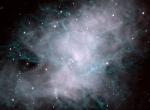 The Crab Nebula in Blue and White
11.07.2000
The Crab Nebula is a complex shell of expanding gas. The Crab Nebula formed from a star that was seen to explode in a supernova about 1000 years ago. This two color composite image taken with the WIYN 3.5-meter telescope shows in great detail filamentary structure of the glowing hydrogen gas.
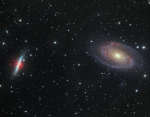 Galaxy Wars: M81 versus M82
23.03.2010
On the right, surrounded by blue spiral arms, is spiral galaxy M81. On the left, marked by red gas and dust clouds, is irregular galaxy M82. This stunning vista shows these two mammoth galaxies locked in gravitational combat, as they have been for the past billion years.
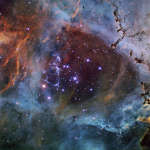 NGC 2244: A Star Cluster in the Rosette Nebula
20.02.2021
In the heart of the Rosette Nebula lies a bright open cluster of stars that lights up the nebula. The stars of NGC 2244 formed from the surrounding gas only a few million years ago.
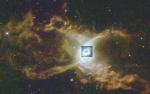 The Red Spider Planetary Nebula
5.01.1998
Oh what a tangled web a planetary nebula can weave. The Red Spider Planetary Nebula shows the complex structure that can result when a normal star ejects its outer gases and becomes a white dwarf star.
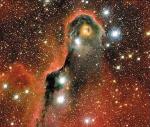 An Unusual Globule in IC 1396
19.10.2003
Is there a monster in IC 1396? Known to some as the Elephant's Trunk Nebula, parts of gas and dust clouds of this star formation region may appear to take on foreboding forms, some nearly human. The only real monster here, however, is a bright young star too far from Earth to hurt us.
 Star Factory Messier 17
7.09.2023
Sculpted by stellar winds and radiation, the star factory known as Messier 17 lies some 5,500 light-years away in the nebula-rich constellation Sagittarius. At that distance, this 1/3 degree wide field of view spans over 30 light-years.
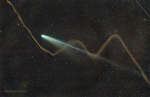 APOD: 2025 October 27 Б Two Tails of Comet Lemmon
26.10.2025
How many bright tails does Comet Lemmon have? Two. In the featured image it appears to have three, but why? The reason is that the zigzagging brown filament is a persistent meteor train that by luck appeared in front of the distant comet C/2025 A6 (Lemmon).
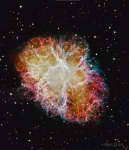 APOD: 2025 December 29 Б M1: The Crab Nebula
28.12.2025
This is the mess that is left when a star explodes. The Crab Nebula, the result of a supernova seen in 1054 AD, is filled with mysterious filaments. The filaments are not only tremendously...
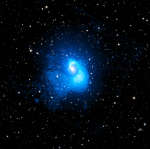 APOD: 2026 May 21 Б A Collision of Galaxy Clusters
20.05.2026
This big beautiful spiral shines in X-ray light. It is about 20 times larger than our Galaxy. It belongs to Abell 2029, a galaxy cluster one billion light-years away. (To see only the galaxies...
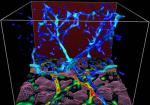 A Universe in a Box
21.08.1997
Is this our universe? Possibly. It is one computerized guess of how gas in the universe was distributed billions of years ago, at redshift 3, when the universe was only a quarter of its present age.
|
January February March April May |
|||||||||||||||||||||||||||||||||||||||||||||||||