
|
You entered: gas
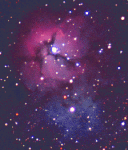 M20: The Trifid Nebula
23.07.1995
The vivid blue and violet colors present in the Trifid Nebula result from the abundance of young stars there. The light from young massive stars is quite blue and has the ability to remove electrons from surrounding gas. When these electrons re-combine with the gas, radiation rich in blue and violet light is emitted.
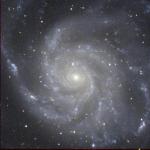 M101: The Pinwheel Galaxy
5.08.1997
Why do many galaxies appear as spirals? A striking example is M101, shown above, whose relatively close distance of about 22 million light years allow it to be studied in some detail. Recent evidence...
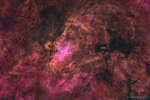 Nest of the Eagle Nebula
4.10.2016
What surrounds the famous Eagle Nebula? The inside of the Eagle Nebula contains eggs -- evaporating gaseous globules -- that typically reside in tremendous pillars of gas and dust and where stars form. This image, though...
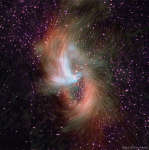 Our Galaxys Magnetic Center
19.06.2019
What's the magnetic field like in the center of our Milky Way Galaxy? To help find out, NASA's SOFIA -- an observatory flying in a modified 747 -- imaged the central region with...
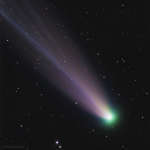 Comet Leonard Closeup from Australia
12.01.2022
What does Comet Leonard look like up close? Although we can't go there, imaging the comet's coma and inner tails through a small telescope gives us a good idea. As the name...
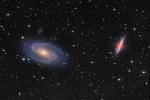 Galaxy Wars: M81 versus M82
15.04.2006
In this stunning cosmic vista, galaxy M81 is on the left surrounded by blue spiral arms. On the right marked by massive gas and dust clouds, is M82. These two mammoth galaxies have been locked in gravitational combat for the past billion years.
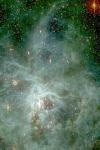 In the Heart of the Tarantula Nebula
27.10.1999
In the heart of monstrous Tarantula Nebula lies one of the most unusual star clusters. Known as NGC 2070 or R136, it is home to a great number of hot young stars. The energetic light from these stars continually ionizes nebula gas, while their energetic particle wind blows bubbles and defines intricate filaments.
 An Unusual Globule in IC 1396
12.12.2022
Is there a monster in IC 1396? Known to some as the Elephant's Trunk Nebula, parts of gas and dust clouds of this star formation region may appear to take on foreboding forms, some nearly human. The only real monster here, however, is a bright young star too far from Earth to hurt us.
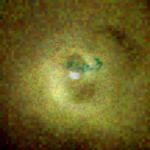 X-Rays From The Perseus Cluster Core
15.06.2000
The Perseus Cluster of thousands of galaxies, 320 million light-years distant, is one of the most massive objects in the Universe. At its core lies the giant cannibal galaxy Perseus A (NGC 1275), accreting matter as gas and galaxies fall into it.
 APOD: 2023 May 31 Б Simulation: A Disk Galaxy Forms
31.05.2023
How did we get here? We know that we live on a planet orbiting a star orbiting a galaxy, but how did all of this form? Since our universe moves too slowly to watch, faster-moving computer simulations are created to help find out.
|
January February March April May |
|||||||||||||||||||||||||||||||||||||||||||||||||