
|
You entered: spring
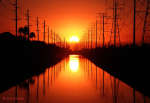 Equinox Plus 1
21.03.2010
Twice a year, at the Spring and Fall equinox, the Sun rises due east. In an emphatic demonstration of this celestial alignment, photographer Joe Orman recorded this inspiring image of the Sun rising exactly along the east-west oriented Western Canal, in Tempe, Arizona, USA.
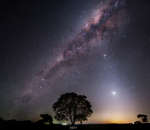 A Light and Dusty Night
2.10.2021
Posing as a brilliant evening star, Venus lies near the western horizon in this southern hemisphere, early spring, night skyscape. To create the composite view exposures tracking the sky and fixed for the foreground were taken on September 25 from Cascavel in southern Brazil.
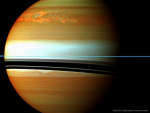 APOD: 2025 October 5 Б A Long Storm System on Saturn
5.10.2025
It was one of the largest and longest lived storms ever recorded in our Solar System. First seen in late 2010, the featured cloud formation in the northern hemisphere of Saturn started larger than the Earth and soon spread completely around the planet.
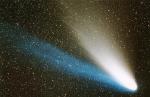 Springtime Comet Fever
20.03.1997
Today marks the Vernal Equinox, the first day of Spring for planet Earth's northern hemisphere. Despite recent attempts by other spectacular and dramatic celestial events to take center stage, Comet Hale-Bopp remains the most popular object in the sky (according to APOD access logs!) and is likely to make this spring memorable for many.
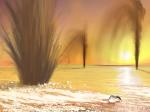 Sandy Gas Jets Hypothesized on Mars
23.08.2006
What's causing seasonal dark spots on Mars? Every spring, strange dark spots appear near the Martian poles, and then vanish a few months later. These spots typically span 50 meters across and appear fan shaped. Recent observations made with THEMIS instrument onboard NASA's Mars Odyssey, currently orbiting Marscarbon dioxide (CO2) ice beneath them.
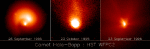 Comet Hale-Bopp Inbound
19.12.1996
Headed toward the inner Solar System, the much anticipated Comet Hale-Bopp has promised to put on a big show next spring. The comet's apparent brightness is currently approaching 4th magnitude and its inbound journey has been closely followed by many observers.
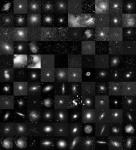 Messier Marathon
11.03.2000
Gripped by an astronomical spring fever, it's once again time for many amateur stargazers to embark on a Messier Marathon! The Vernal Equinox occurs March 20, marking the first day of Spring for the Northern Hemisphere.
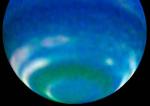 Neptune: Still Springtime After All These Years
13.06.2003
In the 1960s spring came to the southern hemisphere of Neptune, the Solar System's outermost gas giant planet. Of course, since Neptune orbits the Sun once every 165 earth-years, it's still spring for southern Neptune, where each season lasts over four decades.
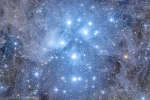 Pleiades: The Seven Sisters Star Cluster
5.12.2022
Have you ever seen the Pleiades star cluster? Even if you have, you probably have never seen it as large and clear as this. Perhaps the most famous star cluster on the sky, the bright stars of the Pleiades can be seen with the unaided eye even from the depths of a light-polluted city.
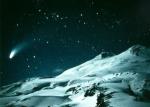 A Hale Bopp Holiday
25.12.1997
Seen from the Pik Terskol Observatory in the northern Caucasus mountains, comet Hale-Bopp and the bright stars of the constellation Perseus hang above the snowy, moon-lit landscape. Although it reminds Northern Hemisphere dwellers of an idyllic Winter scene, this picture was actually recorded in the spring - on April 13th of this year.
|
January February March April May June July August September |
|||||||||||||||||||||||||||||||||||||||||||||||||