
|
You entered: spring
 The Equal Night
23.09.2007
Today, the Sun crosses the celestial equator heading south at 0951 UT. Known as the equinox, the astronomical event marks the first day of autumn in the northern hemisphere and spring in the south.
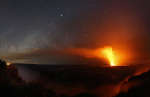 Jupiter Season, Hawaiian Sky
2.06.2018
Volcanic activity on the Big Island of Hawaii has increased since this Hawaiian night skyscape was recorded earlier this year. Recent vents and lava flows are about 30 kilometers to the east, the direction...
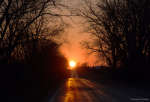 A Picturesque Equinox Sunset
20.03.2022
What's that at the end of the road? The Sun. Many towns have roads that run east - west, and on two days each year, the Sun rises and sets right down the middle. Today is one of those days: an equinox.
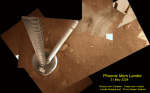 Phoenix and the Snow Queen
12.06.2008
A flat, smooth, shiny feature dubbed the Snow Queen is near the top of this color mosaic of the surface beneath the Phoenix Mars Lander. Recorded with the lander's robotic arm camera as it was maneuvered to look under the lander, the region also includes a leg and plate-sized footpad.
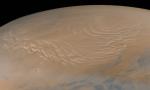 The North Pole Of Mars
24.09.1998
The North Pole of Mars is capped by layers likely consisting of ice and dust deposited over millions of years. Imaged on September 12 - early Spring for Northern Mars - by the Mars Global Surveyor's camera, this synthesized wide-angle color view shows the rippled, eroded polar terrain covered with pinkish seasonal carbon dioxide frost.
 The Equal Night
20.03.2005
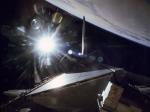
Today, the Sun crosses the celestial equator heading north, marking the Vernal Equinox -- the first day of spring in the Northern Hemisphere and autumn in the south. Equinox means equal night and with the Sun on the celestial equator, Earthlings will experience 12 hours of daylight and 12 hours of darkness.
 Iridescent Clouds from the Top of the World Highway
8.02.2011
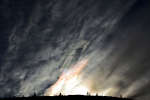
Why would a cloud appear to be different colors? A relatively rare phenomenon known as iridescent clouds can show unusual colors vividly or a whole spectrum of colors simultaneously. These clouds are formed of small water droplets of nearly uniform size.
 Comet McNaught Over New Zealand
19.10.2014
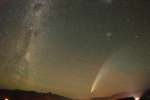
Comet McNaught was perhaps the most photogenic comet of modern times -- from Earth. After making quite a show in the northern hemisphere in early January of 2007, the comet moved south and developed a long and unusual dust tail that dazzled southern hemisphere observers.
 Sunrise Solstice over Stonehenge
20.06.2021
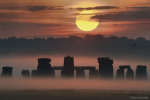
Today the Sun reaches its northernmost point in planet Earth's sky. Called a solstice, many cultures mark this date as a change of seasons -- from spring to summer in Earth's Northern Hemisphere and from fall to winter in Earth's Southern Hemisphere.
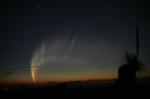 The Magnificent Tail of Comet McNaught
22.01.2007
Comet McNaught, the Great Comet of 2007, has grown a long and filamentary tail. The spectacular tail spreads across the sky and is visible to Southern Hemisphere observers just after sunset. The head of the comet remains quite bright and easily visible to even city observers without any optical aide.
|
January February March April May June July August September |
|||||||||||||||||||||||||||||||||||||||||||||||||