
|
You entered: spring
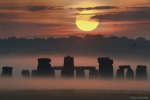 Sunrise Solstice over Stonehenge
20.06.2021
Today the Sun reaches its northernmost point in planet Earth's sky. Called a solstice, many cultures mark this date as a change of seasons -- from spring to summer in Earth's Northern Hemisphere and from fall to winter in Earth's Southern Hemisphere.
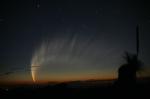 The Magnificent Tail of Comet McNaught
22.01.2007
Comet McNaught, the Great Comet of 2007, has grown a long and filamentary tail. The spectacular tail spreads across the sky and is visible to Southern Hemisphere observers just after sunset. The head of the comet remains quite bright and easily visible to even city observers without any optical aide.
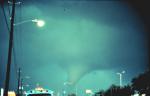 A Tornado on Planet Earth
22.07.2003
Large storms on Earth can spawn unusual, small, violent clouds known as tornadoes. Tornado clouds swirl as fast as hundreds of kilometers per second and, when they touch down, can destroy nearly everything in their long, narrow path. Many tornadoes last only a few minutes, but the largest and most dangerous can endure for hours.
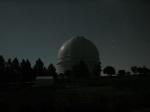 Palomar at Night
7.08.2003
What's wrong with this picture? The summer night sky is clear, and moonlight illuminates the dome of the Hale 200-inch Telescope at Palomar Observatory, northeast of San Diego, California, USA. The familiar stars of the Teapot asterism in the constellation Sagittarius shine above the dome and to the right.
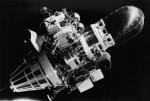 Luna 9: First Soft Lander
7.09.1997
The Luna 9 spacecraft above performed the first soft landing on another planetary body. Following a series of failures, the Soviet probe touched down in the Moon's Oceanus Procellarum region February 3, 1966.
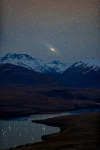 Andromeda in Southern Skies
21.10.2022
Looking north from southern New Zealand, the Andromeda Galaxy never gets more than about five degrees above the horizon. As spring comes to the southern hemisphere, in late September Andromeda is highest in the sky around midnight though.
 Regulus and the Dwarf Galaxy
26.04.2024
In northern hemisphere spring, bright star Regulus is easy to spot above the eastern horizon. The alpha star of the constellation Leo, Regulus is the spiky star centered in this telescopic field of view.
 Luna 9: First Soft Lander
25.08.1996
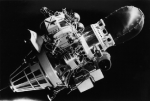
The Luna 9 spacecraft above performed the first soft landing on another planetary body. Following a series of failures, the Soviet probe touched down in the Moon's Oceanus Procellarum region February 3, 1966.
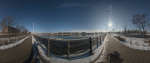 Blue Danube Analemma
29.07.2016
The Sun's annual waltz through planet Earth's sky forms a graceful curve known as an analemma. The analemma's figure 8 shape is tipped vertically at far right in this well-composed fisheye view from Budapest, Hungary.
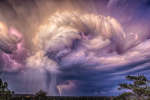 Lightning over Colorado
5.12.2016
Have you ever watched a lightning storm in awe? Join the crowd. Oddly, nobody knows exactly how lightning is produced. What is known is that charges slowly separate in some clouds causing rapid electrical discharges (lightning), but how electrical charges get separated in clouds remains a topic of much research.
|
January February March April May June July August September October November |
||||||||||||||||||||||||||||||||||||||||||||||||||||||||