
|
You entered: image
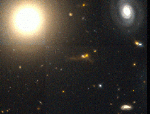 Elliptical Galaxy NGC 4881 in Coma
5.11.1996
Elliptical galaxies are unlike spiral galaxies and hence unlike our own Milky Way Galaxy. The giant elliptical galaxy named NGC 4881 on the upper left lies at the edge of the giant Coma Cluster of Galaxies.
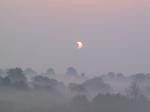 Eclipse in the Mist
4.06.2003
The Sun and Moon rose together over much of Europe on the morning of May 31st with the first solar eclipse of 2003 already in progress. And while sightings of the full annular phase...
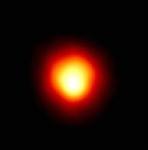 Betelgeuse, Betelgeuse, Betelgeuse
15.02.1997
Betelgeuse (sounds a lot like "beetle juice"), a red supergiant star about 600 light years distant, is seen in this Hubble Space Telescope image -- the first direct picture of the surface of a star other than the Sun. A bright, as yet unexplained hotspot is revealed on its surface!
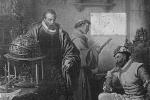 APOD is Two Years Old Today
16.06.1997
The first Astronomy Picture of the Day (APOD) appeared two years ago today. Pictured above is a scene surrounding the creation of an early APOD, depicting the famous astronomer Tycho Brahe demonstrating a celestial globe to Emperor Rudolph II. The image of a possible optical counterpart to a gamma-ray burst appears on the back wall.
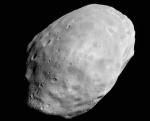 Martian Moon Phobos from MGS
1.07.2003
Why is Phobos so dark? Phobos, the largest and innermost of two Martian moons, is the darkest moon in the entire Solar System. Its unusual orbit and color indicate that it may be a captured asteroid composed of a mixture of ice and dark rock.
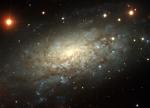 NGC 3621: Far Beyond the Local Group
19.07.2003
Far beyond the local group of galaxies lies NGC 3621, some 22 million light-years away. Found in the serpentine southern constellation Hydra, the loose spiral arms of this gorgeous island universe are loaded with luminous young star clusters and dark dust lanes.
 Opportunity s Horizon
3.02.2004
Remarkably, the Opportunity Mars rover lies in a small martian impact crater about 3 meters deep and 22 meters wide. For 360 degrees, Opportunity's horizon stretches to the right in this new color mosaic image from the rover's panoramic camera.
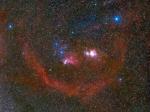 Barnards Loop Around Orion
20.04.2005
Why is the belt of Orion surrounded by a bubble? Although glowing like an emission nebula, the origin of the bubble, known as Barnard's Loop, is currently unknown. Progenitor hypotheses include the winds from bright Orion stars and the supernovas of stars long gone.
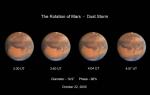 October Mars
28.10.2005
This October, Mars has become a bright, yellowish star in planet Earth's sky as it approaches oppositon, the period when Mars and Earth pass close as they orbit the Sun. How close is Mars? A mere 70 million kilometers or so, close enough to allow Earth-bound astronomers excellent views of the alluring Red Planet.
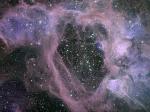 The N44 Superbubble
5.02.2006
What created this gigantic hole? The vast emission nebula N44 in our neighboring galaxy the Large Magellanic Cloud has a large, 250 light-year hole and astronomers are trying to figure out why. One possibility is particle winds expelled by massive stars in the bubble's interior that are pushing out the glowing gas.
|
January February March April May June July August September |
|||||||||||||||||||||||||||||||||||||||||||||||||