
|
You entered: image
 The View from Everest
6.03.2005
What would it be like to stand atop the tallest mountain on Earth? To see a full panoramic vista from there, scroll right. Visible are snow peaked mountains near and far, tremendous cliffs, distant plateaus, the tops of clouds, and a dark blue sky. Mt.
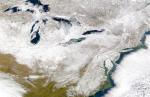 Snowstorm on Planet Earth
31.01.2000
Earth is an ocean planet. From low Earth orbit, the Sea-viewing Wide Field-of-view Sensor (SeaWiFS) instrument onboard NASA's SeaStar spacecraft globally maps ocean color, tracking changes in the climate and biosphere of our water world.
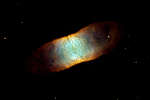 IC 4406: A Seemingly Square Nebula
27.07.2008
How can a round star make a square nebula? This conundrum comes to light when studying planetary nebulae like IC 4406. Evidence indicates that IC 4406 is likely a hollow cylinder, with its square appearance the result of our vantage point in viewing the cylinder from the side.
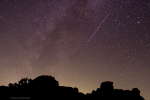 Perseid Trail
14.08.2008
This bright and colorful meteor flashed through Tuesday's early morning skies, part of the annual Perseid Meteor Shower. The lovely image is one of over 350 frames captured on August 12 from...
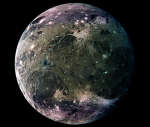 Ganymede Enhanced
20.09.2009
What does the largest moon in the Solar System look like? Ganymede, larger than even Mercury and Pluto, has a surface speckled with bright young craters overlying a mixture of older, darker, more cratered terrain laced with grooves and ridges.
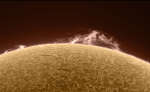 Reinvigorated Sun and Prominence
23.03.2010
Dramatic prominences can sometimes be seen looming just beyond the edge of the sun. Such was the case last week as a giant prominence, visible above on the right, highlighted a Sun showing increased activity as it comes off an unusually quiet Solar Minimum.
 SDO: The Extreme Ultraviolet Sun
23.04.2010
Don't panic, the Sun has not gone wild. But this wild-looking portrait of the nearest star to planet Earth was made on March 30th by the recently launched Solar Dynamics Observatory (SDO). Shown in false-color, the composite view covers extreme ultraviolet wavelengths and traces hot plasma at temperatures approaching 1 million kelvins.
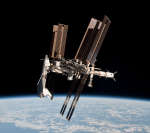 Space Shuttle and Space Station Photographed Together
8.06.2011
How was this picture taken? Usually, pictures of the shuttle, taken from space, are snapped from the space station. Commonly, pictures of the space station are snapped from the shuttle. How, then, can there be a picture of both the shuttle and the station together, taken from space?
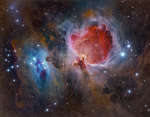 Great Orion Nebulae
13.09.2011
The Great Nebula in Orion, also known as M42, is one of the most famous nebulas in the sky. The star forming region's glowing gas clouds and hot young stars...
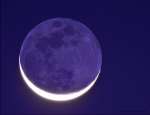 The New Moon in the Old Moon s Arms
24.03.2012
Also known as the Moon's ashen glow, Earthshine is Earthlight illuminating the Moon's night side. Taken on Nowruz, the March 20 equinox, from Esfahan, Iran, planet Earth, this telescopic image captures strong Earthshine from an old Moon. The darker earthlit disk is in the arms of a bright sunlit crescent.
|
January February March April May June July August September |
|||||||||||||||||||||||||||||||||||||||||||||||||