
|
You entered: wind
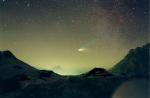 Comet Hale-Bopp Over Val Parola Pass
27.05.2001
Comet Hale-Bopp became much brighter than any surrounding stars. It was seen even over bright city lights. Out away from city lights, however, it put on quite a spectacular show. Here Comet Hale-Bopp was photographed above Val Parola Pass in the Dolomite mountains surrounding Cortina d'Ampezzo, Italy.
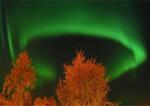 Aurora s Ring
15.10.2002
Gusting solar winds and blasts of charged particles from the Sun made the early days of October rewarding ones for those anticipating aurora. While out enjoying the stormy space weather from Toemmeraas, Norway, Trygve Lindersen recorded this picturesque apparition of the northern lights with a digital camera on October 6.
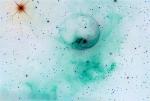 The Bubble Nebula from NOAO
17.06.2003
It's the bubble versus the cloud. NGC 7635, the Bubble Nebula, is being pushed out by the stellar wind of massive central star BD+602522. Next door, though, lives a giant molecular cloud, visible above to the lower right.
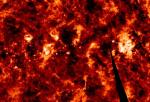 The Frothy Milky Way
2.05.1998
Astronomers have discovered that looking at dust along the plane of our Milky Way Galaxy is a bit like looking into a frothy glass of beer. The dust between stars in our galaxy appears...
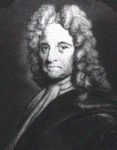 Edmund Halley's Greatest Discoveries
6.07.1996
Sir Edmond Halley was quite a discoverer. Born in 1656, he computed in 1705 that a bright comet was periodic and would make another appearance in 1758. The comet appeared as predicted and is now known as Comet Halley. Unfortunately, Halley died in 1742 and never saw his prediction come true.
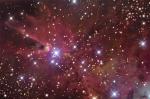 The Mysterious Cone Nebula
25.12.2005
Sometimes the simplest shapes are the hardest to explain. For example, the origin of the mysterious cone-shaped region seen on the far left remains a mystery. The interstellar formation, dubbed the Cone Nebula, is located about 2700 light years away.
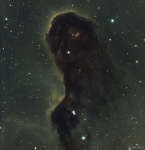 The Dust Monster in IC 1396
2.08.2017
Is there a monster in IC 1396? Known to some as the Elephant's Trunk Nebula, parts of gas and dust clouds of this star formation region may appear to take on foreboding forms, some nearly human. The only real monster here, however, is a bright young star too far from Earth to hurt us.
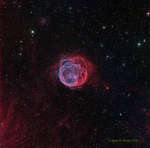 Henize 70: A Superbubble in the LMC
4.02.2019
Massive stars profoundly affect their galactic environments. Churning and mixing interstellar clouds of gas and dust, stars -- most notably those upwards of tens of times the mass of our Sun -- leave their mark on the compositions and locations of future generations of stars.
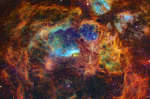 NGC 6357: The Lobster Nebula
28.10.2020
Why is the Lobster Nebula forming some of the most massive stars known? No one is yet sure. Cataloged as NGC 6357, the Lobster Nebula houses the open star cluster Pismis 24 near its center -- a home to unusually bright and massive stars.
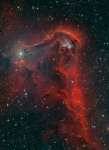 RCW 85
14.06.2024
From the 1960 astronomical catalog of Rodgers, Campbell and Whiteoak, emission region RCW 85 shines in southern night skies between bright stars Alpha and Beta Centauri. About 5,000 light years distant, the hazy interstellar cloud of glowing hydrogen gas and dust is faint.
|
January February March April May June |
|||||||||||||||||||||||||||||||||||||||||||||||||