
|
You entered: wind
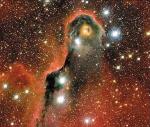 An Unusual Globule in IC 1396
25.03.2002
Is there a monster in IC 1396? Known to some as the Elephant's Trunk Nebula, parts of gas and dust clouds of this star formation region may appear to take on foreboding forms, some nearly human. The only real monster here, however, is a bright young star too far from Earth to hurt us.
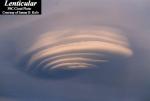 A Lenticular Cloud Over New Hampshire
30.04.2003
Why does this cloud look so strange? Actually, pictured above are several clouds all stacked up into one striking lenticular cloud. Normally, air moves much more horizontally than it does vertically. Sometimes, however, such as when wind comes off of a mountain or a hill, relatively strong vertical oscillations take place as the air stabilizes.
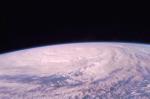 Super Typhoon Winnie
19.08.1997
Super Typhoon Winnie raged through parts of the Eastern Hemisphere last week. Swirling in the Pacific Ocean with winds in excess of 160 miler per hour, Winnie became one of the stronger storm systems in modern times: a Category 5 Hurricane.
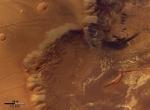 Melas Chasma
29.07.2004
Steep cliffs drop into the rugged terrain of Melas Chasma in this stunning view from the Mars Express spacecraft orbiting the Red Planet. At a scale of 16 meters per pixel, the image data...
 The Snake Nebula from CFHT
9.04.2002
What slithers overhead? The dark winding lanes visible in part of the constellation of Ophiuchus belong to the Snake Nebula. Also known as Barnard 72, the Snake Nebula is a series of dark absorption clouds made up of molecular gas and interstellar dust.
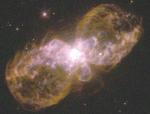 The Hubble 5 Planetary Nebula
19.01.1998
The Hubble Double Bubble Planetary Nebula is bubbling over with excitement. More mundanely known as Hubble 5, this bipolar planetary nebula is being created by a hot wind of particles streaming away from the central star system.
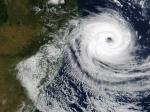 Unusually Strong Cyclone Off the Brazilian Coast
6.04.2004
How did this huge cyclone form? An unusually strong storm -- perhaps the strongest storm in the recorded history of the South Atlantic Ocean -- crossed the coast of Brazil last week. Cyclones this powerful, classified by some as the first ever Category 1 Hurricane, are very rare in the South Atlantic.
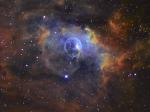 NGC 7635: The Bubble Nebula
7.11.2005
It's the bubble versus the cloud. NGC 7635, the Bubble Nebula, is being pushed out by the stellar wind of massive central star BD+602522. Next door, though, lives a giant molecular cloud, visible above to the lower right.
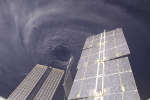 Hurricane Ivan from the Space Station
13.01.2008
Ninety percent of the houses on Grenada were damaged by the destructive force of Hurricane Ivan. At its peak, Ivan was a Category 5 hurricane, the highest power category on the Saffir-Simpson Scale, and created sustained winds in excess of 200 kilometers per hour.
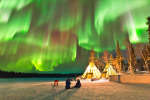 Auroras over Northern Canada
14.07.2014
Gusting solar winds and blasts of charged particles from the Sun resulted in several rewarding nights last December for those anticipating auroras. The above image captured dramatic auroras stretching across a sky near the town of Yellowknife in northern Canada.
|
January February March April May June July August |
||||||||||||||||||||||||||||||||||||||||||||||||||||||||