
|
You entered: wind
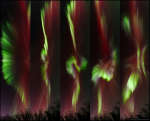 Alaska Aurora Sequence
28.12.2013
A remarkably intense auroral band flooded the northern night with shimmering colors on December 7. The stunning sequence captured here was made with a camera fixed to a tripod under cold, clear skies near Ester, just outside of Fairbanks, Alaska.
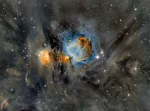 Orion Nebula in Surrounding Dust
25.03.2014
What surrounds a hotbed of star formation? In the case of the Orion Nebula -- dust. The entire Orion field, located about 1600 light years away, is inundated with intricate and picturesque filaments of dust.
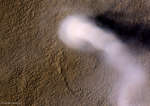 A Dust Devil on Mars
2.03.2015
It was late in the northern martian spring when the HiRISE camera onboard the Mars Reconnaissance Orbiter spied this local denizen. Tracking across the flat, dust-covered Amazonis Planitia in 2012, the core of this whirling dust devil is about 140 meters in diameter.
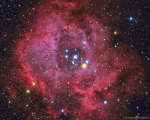 The Rosette Nebula
14.02.2017
Would the Rosette Nebula by any other name look as sweet? The bland New General Catalog designation of NGC 2237 doesn't appear to diminish the appearance of this flowery emission nebula. Inside the nebula lies an open cluster of bright young stars designated NGC 2244.
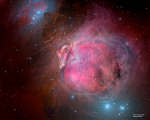 The Great Turkey Nebula
26.11.2020
Surprisingly reminiscent of The Great Nebula in Orion, The Great Turkey Nebula spans this creative field of view. Of course if it were the Orion Nebula it would be our closest large stellar nursery, found at the edge of a large molecular cloud a mere 1,500 light-years away.
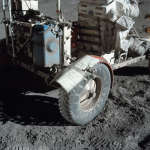 Lunar Dust and Duct Tape
29.05.2021
Why is the Moon so dusty? On Earth, rocks are weathered by wind and water, creating soil and sand. On the Moon, the history of constant micrometeorite bombardment has blasted away at the rocky surface creating a layer of powdery lunar soil or regolith.
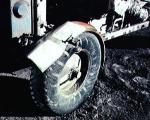 Lunar Dust and Duct Tape
1.05.1999
Why is the Moon dusty? On Earth, rocks are weathered by wind and water, creating soil and sand. On the Moon, the long history of micrometeorite bombardment has blasted away at the rocky surface creating a layer of powdery lunar soil or regolith. This lunar regolith could be a scientific and industrial bonanza.
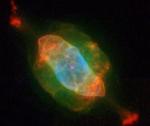 NGC 7009: The Saturn Nebula
30.12.1997
The layers of the Saturn Nebula give a complex picture of how this planetary nebula was created. The above picture, taken in April 1996 and released last week, allows a better understanding of the mysterious process that transformed a low-mass star into a white dwarf star.
 Two Hours Before Neptune
5.10.1999
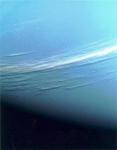
Two hours before closest approach to Neptune in 1989, the Voyager 2 robot spacecraft snapped this picture. Clearly visible for the first time were long light-colored cirrus-type clouds floating high in Neptune's atmosphere. Shadows of these clouds can even be seen on lower cloud decks.
 The Rosette Nebula in Hydrogen and Oxygen
24.02.2015
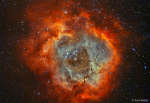
The Rosette Nebula is not the only cosmic cloud of gas and dust to evoke the imagery of flowers -- but it is the most famous. At the edge of a large molecular cloud...
|
January February March April May June July August |
||||||||||||||||||||||||||||||||||||||||||||||||||||||||