
|
You entered: satellite
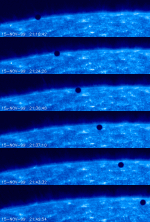 Mercury And The Sun
18.11.1999
Just days before the peak of the Leonid meteor shower, skywatchers were offered another astronomical treat as planet Mercury crossed the face of the Sun on November 15. Viewed from planet Earth, a transit of Mercury is not all that rare. The last occurred in 1993 and the next will happen in 2003.
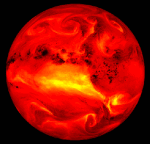 The Water Vapor Channel
4.09.1999
What alien planet's bizarre landscape lurks below these fiery-looking clouds? It's only Planet Earth, of course ... as seen on the Water Vapor Channel. Hourly, images like this one (an infrared image shown in false color) are brought to you by the orbiting Geostationary Operational Environmental Satellites' (GOES) multi-channel imagers.
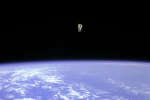 To Fly Free in Space
1.01.2012
At about 100 meters from the cargo bay of the space shuttle Challenger, Bruce McCandless II was farther out than anyone had ever been before. Guided by a Manned Maneuvering Unit (MMU), astronaut McCandless, pictured above, was floating free in space.
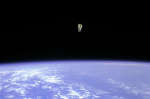 To Fly Free in Space
30.12.2017
What would it be like to fly free in space? At about 100 meters from the cargo bay of the space shuttle Challenger, Bruce McCandless II was living the dream -- floating farther out than anyone had ever been before. Guided by a Manned Maneuvering Unit (MMU), astronaut McCandless, pictured, was floating free in space.
 The Falcon and the Redstone
2.08.2023
In a photo from the early hours of July 29 (UTC), a Redstone rocket and Mercury capsule are on display at Cape Canaveral Launch Complex 5. Beyond the Redstone, the 8 minute long exposure has captured the arcing launch streak of a SpaceX Falcon Heavy rocket.
 An Anomalous SETI Signal
5.02.2011
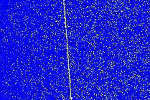
No one knows for sure what caused this signal. There is a slight possibility that it just might originate from an extraterrestrial intelligence. The bright colors on the blue background indicate that an anomalous signal was received here on Earth by a radio telescope involved in a Search for Extraterrestrial Intelligence (SETI).
 Habitable Worlds
3.03.2014
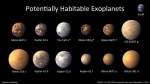
Is Earth the only known world that can support life? In an effort to find life-habitable worlds outside our Solar System, stars similar to our Sun are being monitored for slight light decreases that indicate eclipsing planets. Many previously-unknown planets are being found, including over 700 worlds recently uncovered by NASA's Kepler satellite.
 A Twisted Solar Eruptive Prominence
24.01.2015
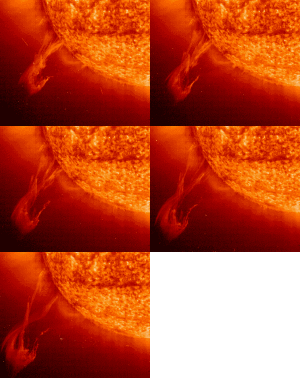
Ten Earths could easily fit in the "claw" of this seemingly solar monster. The monster, actually a huge eruptive prominence, is seen moving out from our Sun in this condensed half-hour time-lapse sequence. This large prominence, though, is significant not only for its size, but its shape.
 Gaia's Milky Way
26.04.2018
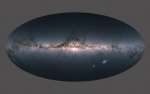
This grand allsky view of our Milky Way and nearby galaxies is not a photograph. It's a map based on individual measurements for nearly 1.7 billion stars. The astronomically rich data set used...
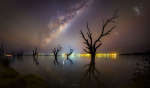 Dark Sky Reflections
28.06.2020
When the lake calmed down, many wonders of the land and sky appeared twice. Perhaps the most dramatic from the dark sky was the central band of our Milky Way Galaxy, visible as a diagonal band. Toward the right were both the Small (SMC) and Large (LMC) Magellanic Clouds, satellite galaxies of our Milky Way.
|
January February |
|||||||||||||||||||||||||||||||||||||||||||||||||