
|
You entered: satellite
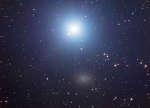 Bright Star Regulus near the Leo I Dwarf Galaxy
10.01.2012
The star near the top is so bright that it is sometimes hard to notice the galaxy toward the bottom. Pictured above, both the star, Regulus, and the galaxy, Leo I, can be found within one degree of each other toward the constellation of the Lion (Leo).
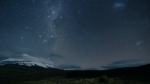 Nocturnal: Scenes from the Southern Night
6.08.2012
Have you ever seen the night sky change? It does -- sometimes in beautiful and unexpected ways. To see it, though, usually requires patience. The above award winning video shows several of the possible changes in dramatic fashion with a time lapse video.
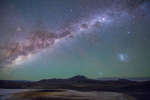 Galaxies from the Altiplano
13.10.2016
The central bulge of our Milky Way Galaxy rises over the northern Chilean Atacama altiplano in this postcard from planet Earth. At an altitude of 4500 meters, the strange beauty of the desolate landscape could almost belong to another world though.
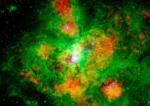 30 Doradus Across the Spectrum
24.12.1997
30 Doradus is lit up like a Christmas tree. Shining in light across the electromagnetic spectrum, 30 Doradus glows because of all the energetic processes that go on there. A distinctive region visible...
 N11: A Giant Ring of Emission Nebulas
6.10.2004
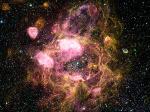
How did this unusually large nebula form? One of the largest nebulas yet detected is actually a complex ring of emission nebulas connected by glowing filaments. The unusual network, known as N11, spans over...
 X ray Transit of Mercury
6.11.1999
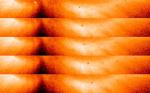
This sequence of false color X-ray images captures a rare event - the passage or transit of planet Mercury in front of the Sun. Mercury's small disk is silhouetted against the bright background of X-rays from the hot Solar Corona.
 Infrared Horsehead
24.02.2001
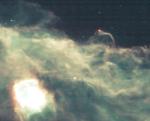
This famous cosmic dust cloud was imaged in infrared light by the European Space Agency's Infrared Space Observatory (ISO) satellite. The false-color picture shows the bright infrared emission from dust and molecular gas in part of the Orion star forming region surrounding the Horsehead Nebula.
 A Twisted Solar Eruptive Prominence
3.04.2000
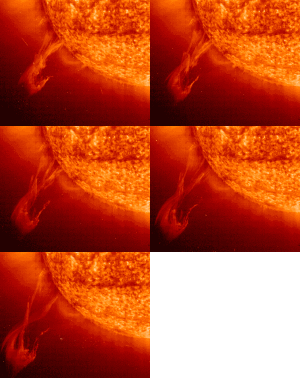
A huge eruptive prominence is seen moving out from our Sun in this condensed half-hour time-lapse sequence. Ten Earths could easily fit in the "claw" of this seemingly solar monster. This large prominence, though, is significant not only for its size, but its shape.
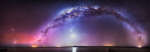 From the Northern to the Southern Cross
27.01.2019
There is a road that connects the Northern to the Southern Cross but you have to be at the right place and time to see it. The road, as pictured here, is actually...
 APOD: 2024 June 26 Б Timelapse: Aurora, SAR, and the Milky Way
26.06.2024
What's happening in the sky this unusual night? Most striking in the featured 4.5-hour 360-degree panoramic video, perhaps, is the pink and purple aurora. That's because this night, encompassing May 11, was famous for its auroral skies around the world.
|
January February |
|||||||||||||||||||||||||||||||||||||||||||||||||