
|
You entered: sky
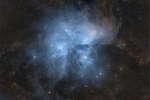 Messier 45: The Daughters of Atlas and Pleione
4.01.2023
Hurtling through a cosmic dust cloud a mere 400 light-years away, the lovely Pleiades or Seven Sisters open star cluster is well-known for its striking blue reflection nebulae. It lies in the night sky toward the constellation Taurus and the Orion Arm of our Milky Way galaxy.
 A High Energy Fleet
24.11.2000
Like a fleet of futuristic starcruisers, NASA's highly successful series of High Energy Astrophysical Observatory (HEAO) spacecraft appear poised over planet Earth. Labeled A, B, and C in this vintage illustration, the spacebased telescopes were known as HEAO-1, HEAO-2, and HEAO-3 respectively.
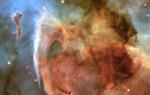 Colorful Clouds Of Carina
17.06.2001
Tumultuous clouds of the Carina Nebula, 8000 light-years away, glow in planet Earth's southern sky. Striking and detailed, this close-up of a portion of the famous nebula is a combination of exposures through six different filters taken with the Hubble Space Telescope's Wide Field Planetary Camera 2 in April of 1999.
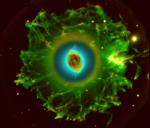 Halo of the Cat's Eye
31.10.2003
The Cat's Eye Nebula (NGC 6543) is one of the best known planetary nebulae in the sky. Its haunting symmetries are seen in the very central region of this stunning false-color picture, processed...
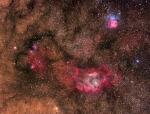 Sagittarius Triplet
4.08.2007
These three bright nebulae are often featured in telescopic tours of the constellation Sagittarius and the crowded starfields of the central Milky Way. In fact, 18th century cosmic tourist Charles Messier cataloged two of them; M8, the nebula below and right of center, and colorful M20 at the upper right.
 Curiosity Before Mars: Seven Minutes of Terror
31.07.2012
Next week at this time, there may be an amazing new robotic explorer on Mars. Or there may be a new pile of junk. It all likely depends on many things going correctly in the minutes after the Mars Science Laboratory mission arrives at Mars and attempts to deploy the Curiosity rover from orbit.
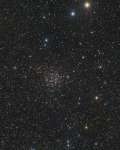 NGC 7789: Caroline s Rose
26.10.2013
Found among the rich starfields of the Milky Way toward the constellation Cassiopeia, star cluster NGC 7789 lies about 8,000 light-years away. A late 18th century deep sky discovery of astronomer Caroline Lucretia Herschel, the cluster is also known as Caroline's Rose.
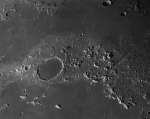 Plato and the Lunar Alps
3.12.2014
The dark-floored, 95 kilometer wide crater Plato and sunlit peaks of the lunar Alps (Montes Alpes) are highlighted in this sharp digital snapshot of the Moon's surface. While the Alps of planet Earth...
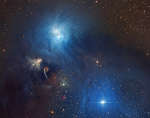 Stars and Dust in Corona Australis
7.01.2015
Cosmic dust clouds and young, energetic stars inhabit this telescopic vista, less than 500 light-years away toward the northern boundary of Corona Australis, the Southern Crown. The dust clouds effectively block light from more distant background stars in the Milky Way.
 APOD: 2023 October 1 Б A Desert Eclipse
30.09.2023
A good place to see a ring-of-fire eclipse, it seemed, would be from a desert. In a desert, there should be relatively few obscuring clouds and trees. Therefore late December of 2019, a group...
|
January February March April May June July August September October |
|||||||||||||||||||||||||||||||||||||||||||||||||