
|
You entered: sky
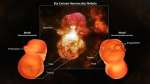 3D Homunculus Nebula
17.07.2014
If you're looking for something to print with that new 3D printer, try out a copy of the Homunculus Nebula. The dusty, bipolar cosmic cloud is around 1 light-year across but is slightly scaled down for printing to about 1/4 light-nanosecond or 80 millimeters.
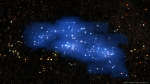 Hyperion: Largest Known Galaxy Proto Supercluster
23.10.2018
How did galaxies form in the early universe? To help find out, astronomers surveyed a patch of dark night sky with the Very Large Telescope array in Chile to find and count galaxies that formed when our universe was very young.
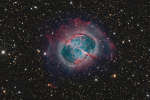 M27: Not a Comet
29.08.2019
While hunting for comets in the skies above 18th century France, astronomer Charles Messier diligently kept a list of the things he encountered that were definitely not comets. This is number 27 on his now famous not-a-comet list.
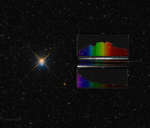 Beautiful Albireo AB
24.02.2022
Beta Cygni is a single bright star to the naked eye. About 420 light-years away it marks the foot of the Northern Cross, famous asterism in the constellation Cygnus. But a view through...
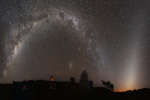 Zodiacal Light Over Namibia
13.09.2010
An unusual triangle of light is visible this time of year just before dawn, in the northern hemisphere. Once considered a false dawn, this triangle of light is actually zodiacal light, light reflected from interplanetary dust particles.
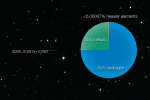 J102815: A Star That Should Not Exist
7.09.2011
Why does this star have so few heavy elements? Stars born in the generation of our Sun have an expected abundance of elements heavier than hydrogen and helium mixed into their atmospheres. Stars born...
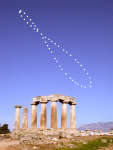 Apollo s Analemma
22.09.2013
Today, the Sun crosses the celestial equator heading south at 20:44 Universal Time. An equinox (equal night), this astronomical event marks the first day of autumn in the northern hemisphere and spring in the south.
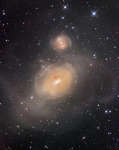 NGC 1316: After Galaxies Collide
2.02.2017
An example of violence on a cosmic scale, enormous elliptical galaxy NGC 1316 lies about 75 million light-years away toward Fornax, the southern constellation of the Furnace. Investigating the startling sight, astronomers suspect the giant galaxy of colliding with smaller neighbor NGC 1317 seen just above, causing far flung loops and shells of stars.
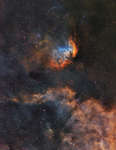 The Tulip and Cygnus X 1
29.07.2021
This tall telescopic field of view looks out along the plane of our Milky Way Galaxy toward the nebula rich constellation Cygnus the Swan. Popularly called the Tulip Nebula, the brightest glowing cloud of interstellar gas and dust above center is also found in the 1959 catalog by astronomer Stewart Sharpless as Sh2-101.
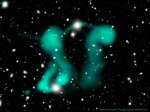 Dancing Ghosts: Curved Jets from Active Galaxies
1.09.2021
Why would galaxies emit jets that look like ghosts? And furthermore, why do they appear to be dancing? The curled and fluffy jets from the supermassive black holes at the centers of two host galaxies (top center and lower left) are unlike anything seen before.
|
January February March April May June July August September October |
|||||||||||||||||||||||||||||||||||||||||||||||||