
|
You entered: sky
 APOD: 2023 April 11 Б North Star: Polaris and Surrounding Dust
11.04.2023
Why is Polaris called the North Star? First, Polaris is the nearest bright star toward the north spin axis of the Earth. Therefore, as the Earth turns, stars appear to revolve around Polaris, but Polaris itself always stays in the same northerly direction -- making it the North Star.
 Supernova Remnant Cassiopeia A
17.01.2025
Massive stars in our Milky Way Galaxy live spectacular lives. Collapsing from vast cosmic clouds, their nuclear furnaces ignite and create heavy elements in their cores. After only a few million years for the most massive stars, the enriched material is blasted back into interstellar space where star formation can begin anew.
 Pleiades, Planets, And Hot Plasma
24.05.2000
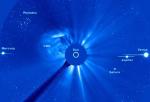
Bright stars of the Pleiades, four planets, and erupting solar plasma are all captured in this spectacular image from the space-based SOlar and Heliospheric Observatory (SOHO). In the foreground of the 15 degree wide field of view, a bubble of hot plasma, called a Coronal Mass Ejection (CME)
 Cat s Eye Hubble Remix
22.03.2008
Staring across interstellar space, the alluring Cat's Eye Nebula lies three thousand light-years from Earth. One of the most famous planetary nebulae in the sky, the Cat's Eye (NGC 6543) is over half a light-year across and represents a final, brief yet glorious phase in the life of a sun-like star.
 Rosetta Spacecraft Passes Asteroid Steins
8.09.2008
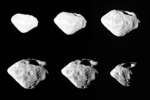
What's that diamond in the sky? Cruising though space, sometimes you'll come across an unusual object. Such was the case on Friday for ESA's Rosetta spacecraft on it's way to comet Churyumov-Gerasimenko in 2014.
 M27: Not a Comet
1.09.2011
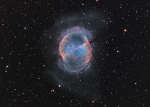
While hunting for comets in the skies above 18th century France, astronomer Charles Messier diligently kept a list of the things he encountered that were definitely not comets. This is number 27 on his now famous not-a-comet list.
 Comet Lemmon near the South Celestial Pole
7.02.2013
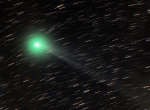
Currently sweeping through southern skies, Comet Lemmon (C/2012 F6) was named for its discovery last year as part of the Mount Lemmon (Arizona) Survey. Brighter than expected but still just below naked-eye visibility, Comet Lemmon sports a stunning lime green coma and faint divided tail in this telescopic image from February 4.
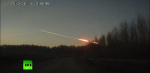 The Great Russian Meteor of 2013
18.02.2013
What in heaven's blazes is that? Thousands of people living near the Ural Mountains in Russia saw last Friday morning one of the more spectacular meteors of modern times streak across the sky. Forceful sound waves arrived at the ground minutes later, knocking people over and breaking windows for hundreds of kilometers.
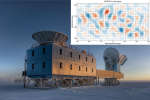 Cosmic Microwave Map Swirls Indicate Inflation
18.03.2014
Did the universe undergo an early epoch of extremely rapid expansion? Such an inflationary epoch has been postulated to explain several puzzling cosmic attributes such as why our universe looks similar in opposite directions.
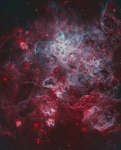 The Tarantula Zone
13.11.2020
The Tarantula Nebula, also known as 30 Doradus, is more than a thousand light-years in diameter, a giant star forming region within nearby satellite galaxy the Large Magellanic Cloud. About 180 thousand light-years away, it's the largest, most violent star forming region known in the whole Local Group of galaxies.
|
January February March April May June July August September October |
|||||||||||||||||||||||||||||||||||||||||||||||||