
|
You entered: sky
 A Giant Squid in the Flying Bat
27.10.2016
Very faint but also very large on planet Earth's sky, a giant Squid Nebula cataloged as Ou4, and Sh2-129 also known as the Flying Bat Nebula, are both caught in this cosmic scene toward the royal constellation Cepheus.
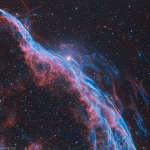 NGC 6960: The Witchs Broom Nebula
8.04.2018
Ten thousand years ago, before the dawn of recorded human history, a new light would have suddenly have appeared in the night sky and faded after a few weeks. Today we know this light was from a supernova, or exploding star, and record the expanding debris cloud as the Veil Nebula, a supernova remnant.
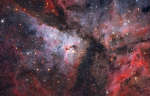 The Great Carina Nebula
27.12.2018
A jewel of the southern sky, the Great Carina Nebula, also known as NGC 3372, spans over 300 light-years, one of our galaxy's largest star forming regions. Like the smaller, more northerly Great...
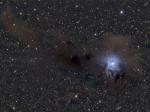 Wisps of the Iris Nebula
26.06.2007
Like delicate cosmic petals, these clouds of interstellar dust and gas have blossomed 1,300 light-years away in the fertile star fields of the constellation Cepheus. Sometimes called the Iris Nebula and dutifully cataloged as NGC 7023, this is not the only nebula in the sky to evoke the imagery of flowers.
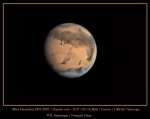 Mars in View
6.12.2007
Very good telescopic views of Mars can be expected in the coming weeks as the Red Planet nears opposition on December 24th. Of course, opposition means opposite the Sun in planet Earth's sky - an arrangement that occurs every 26 months for Mars.
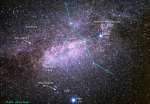 Where is HD 189733
21.03.2008
The star cataloged as HD 189733 is a mere 63 light-years away. Its location is indicated in this deep, wide-angle image of the sky centered on the northern constellation of Cygnus. Considering the many...
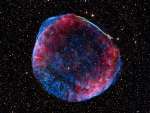 SN 1006 Supernova Remnant
1.08.2009
A new star, likely the brightest supernova in recorded human history, lit up planet Earth's sky in the year 1006 AD. The expanding debris cloud from the stellar explosion, found in the southerly constellation of Lupus, still puts on a cosmic light show across the electromagnetic spectrum.
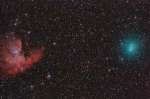 Pacman and Hartley
7.10.2010
Touring the solar system with a 6 year orbital period, small comet Hartley 2 (103/P Hartley) will make its closest approach to planet Earth on October 20 and its closest approach to the Sun on October 28. It may become a naked-eye comet, just visible in clear, dark skies.
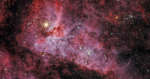 The Great Carina Nebula
27.05.2016
A jewel of the southern sky, the Great Carina Nebula, also known as NGC 3372, spans over 300 light-years, one of our galaxy's largest star forming regions. Like the smaller, more northerly Great...
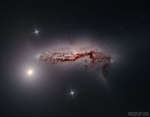 Galaxy Group Hickson 90
17.05.2017
Scanning the skies for galaxies, Canadian astronomer Paul Hickson and colleagues identified some 100 compact groups of galaxies, now appropriately called Hickson Compact Groups (HCGs). This sharp Hubble image shows one such galaxy group, HCG 90, in startling detail.
|
January February March April May June July August September October |
|||||||||||||||||||||||||||||||||||||||||||||||||