
|
You entered: ancient
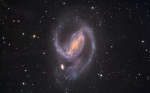 In the Arms of NGC 1097
8.01.2015
Spiral galaxy NGC 1097 shines in southern skies, about 45 million light-years away in the chemical constellation Fornax. Its blue spiral arms are mottled with pinkish star forming regions in this colorful galaxy portrait.
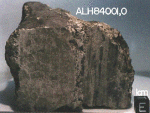 A Meteorite From Mars
17.08.1996
The famous Martian meteorite pictured above houses microscopic structures interpreted by many as fossils of ancient Martian life. How do you find a meteorite from Mars here on Earth? On a typical day, several large rocks fall to Earth from space, usually winding up in the oceans.
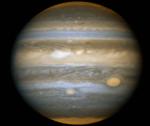 Jupiter and the Red Spots
5.05.2006
Jupiter's Great Red Spot is a swirling storm seen for over 300 years, since the beginning of telescopic observations. But in February 2006, planetary imager Christopher Go noticed it had been joined by Red Spot Jr - formed as smaller whitish oval-shaped storms merged and then developed the remarkable reddish hue.
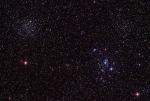 Star Clusters Young and Old
10.09.2006
Many stars form in clusters. Galactic or open star clusters are relatively young swarms of bright stars born together near the plane of our Milky Way Galaxy. Separated by about a degree...
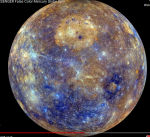 All of Mercury
28.04.2019
Only six years ago, the entire surface of planet Mercury was finally mapped. Detailed observations of the innermost planet's surprising crust began when the robotic have been ongoing since the robotic MESSENGER spacecraft first passed Mercury in 2008 and continued until its controlled crash landing in 2015.
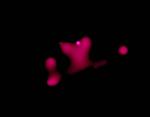 The Heart in NGC 346
14.02.2003
Yes, it's Valentine's Day (!) and looking toward star cluster NGC 346 in our neighboring galaxy the Small Magellanic Cloud, astronomers have noted this heart-shaped cloud of hot, x-ray emitting gas in the cluster's central region.
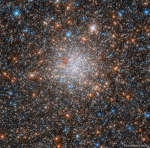 NGC 1898: Globular Cluster in the LMC
3.10.2018
Jewels don't shine this bright -- only stars do. And almost every spot in this glittering jewel-box of an image from the Hubble Space Telescope is a star. Now some stars are more red than our Sun, and some more blue -- but all of them are much farther away.
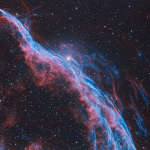 NGC 6960: The Witch s Broom Nebula
29.05.2013
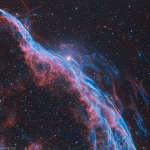
Ten thousand years ago, before the dawn of recorded human history, a new light would have suddenly have appeared in the night sky and faded after a few weeks. Today we know this light was from a supernova, or exploding star, and record the expanding debris cloud as the Veil Nebula, a supernova remnant.
 NGC 6960: The Witchs Broom Nebula
8.04.2018
Ten thousand years ago, before the dawn of recorded human history, a new light would have suddenly have appeared in the night sky and faded after a few weeks. Today we know this light was from a supernova, or exploding star, and record the expanding debris cloud as the Veil Nebula, a supernova remnant.
 Ultima Thule from New Horizons
29.01.2019
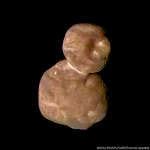
How do distant asteroids differ from those near the Sun? To help find out, NASA sent the robotic New Horizons spacecraft past the classical Kuiper belt object 2014 MU69, nicknamed Ultima Thule, the farthest asteroid yet visited by a human spacecraft.
|
January February March April May June July August September |
|||||||||||||||||||||||||||||||||||||||||||||||||