
|
You entered: ancient
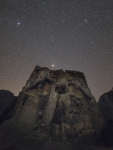 Mars, Pleiades, and Andromeda over Stone Lions
13.10.2020
Three very different -- and very famous -- objects were all captured in a single frame last month. On the upper left is the bright blue Pleiades, perhaps the most famous cluster of stars on the night sky. The Pleiades (M45) is about 450 light years away and easily found a few degrees from Orion.
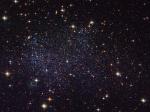 Sagittarius Dwarf Irregular Galaxy
16.11.2004
How old is this galaxy? The nearby Local Group galaxy dubbed the Sagittarius Dwarf Irregular Galaxy (SagDIG) is not only very small but also has relatively few elements more massive than helium.
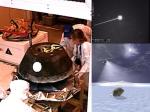 Stardust Capsule Returns to Earth
16.01.2006
A flying saucer from outer space crash-landed in the Utah desert yesterday after being tracked by radar and chased by helicopters and airplanes. Like last time, no space aliens were involved. The saucer...
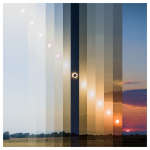 APOD: 2026 September 2 Б Solar Eclipses and Culture
2.09.2026
Pretend you have never heard of a solar eclipse. The SunБs behavior has been predictable your whole life. One day, you witness the sky transform as it does in todayБs spliced image spanning two hours of the August 12, 2026 solar eclipse. The Sun disappears, leaving behind a bright, empty ring.
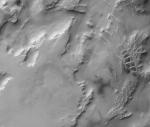 Rectangular Ridges on Mars
1.10.2002
What could cause rectangular ridges on Mars? As data flows in from the two spacecraft currently orbiting Mars, surface structures are seen that are not immediately understood. These structures pose puzzles that planetary geologists are eager to solve, as they might provide clues to past processes that have shaped Mars over billions of years.
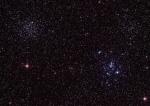 Stars Young and Old
4.08.2005
Galactic or open star clusters are relatively young swarms of bright stars born together near the plane of our Milky Way Galaxy. Separated by about a degree on the sky, two nice examples...
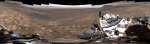 Mars Panorama from Curiosity
6.03.2020
The Mars Rover named Curiosity recorded high-resolution, 360 degree views of its location on Mars late last year. The panoramic scene was stitched from over 1,000 images from Curiosity's Mast camera or Mastcam.
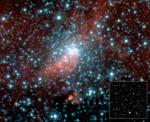 Glimpse of a Globular Star Cluster
14.10.2004
Not a glimpse of this cluster of stars can be seen in the inset visible light image (lower right). Still, the infrared view from the Spitzer Space Telescope reveals a massive globular star cluster of about 300,000 suns in an apparently empty region of sky in the constellation Aquila.
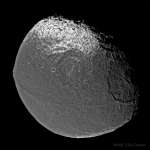 APOD: 2023 February 26 Б Saturns Iapetus: Moon with a Strange Surface
26.02.2023
What would make a moon look like a walnut? A strange ridge that circles Saturn's moon Iapetus's equator, visible near the bottom of the featured image, makes it appear similar to a popular edible nut.
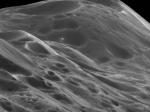 4000 Kilometers Above Saturns Iapetus
19.09.2007
What does the surface of Saturn's mysterious moon Iapetus look like? To help find out, the robotic Cassini spacecraft now orbiting Saturn was sent soaring last week just 2,000 kilometers from the unique equatorial ridge of the unusual walnut-shaped two-toned moon.
|
January February March April May June July August September |
|||||||||||||||||||||||||||||||||||||||||||||||||