
|
You entered: nearby
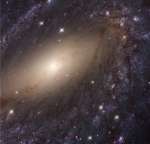 NGC 6744 Close Up
31.05.2018
Beautiful spiral galaxy NGC 6744 is nearly 175,000 light-years across, larger than our own Milky Way. It lies some 30 million light-years distant in the southern constellation Pavo, its galactic disk tilted towards our line of sight.
 APOD: 2023 July 26 Б IC 4628: The Prawn Nebula
26.07.2023
South of Antares, in the tail of the nebula-rich constellation Scorpius, lies emission nebula IC 4628. Nearby hot, massive stars, millions of years young, irradiate the nebula with invisible ultraviolet light, stripping electrons from atoms. The electrons eventually recombine with the atoms to produce the visible nebular glow, dominated by the red emission of hydrogen.
 APOD: 2024 June 25 Б The Dark Doodad Nebula
25.06.2024
What is that strange brown ribbon on the sky? When observing the star cluster NGC 4372, observers frequently take note of an unusual dark streak nearby running about three degrees in length. The streak, actually a long molecular cloud, has become known as the Dark Doodad Nebula.
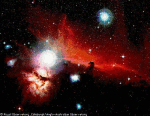 Orion's Horsehead Nebula
3.01.1999
The Horsehead Nebula is one of the most famous nebulae on the sky. It is visible as the black indentation to the red emission nebula seen just to the right of center of the above photograph. The bright star near the center is located in the belt of the familiar constellation of Orion.
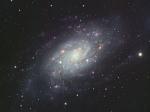 Spiral Galaxy NGC 2403 from Subaru
5.07.2006
Sprawling spiral arms dotted with bright red emission nebulas highlight this new and detailed image of nearby spiral galaxy NGC 2403. Also visible in the photogenic spiral galaxy are blue open clusters, dark dust lanes, and a bright but relatively small central nucleus.
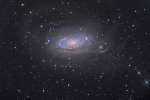 Messier 63: The Sunflower Galaxy
17.04.2008
A bright spiral galaxy of the northern sky, Messier 63 is about 25 million light-years distant in the loyal constellation Canes Venatici. Also cataloged as NGC 5055, the majestic island universe is nearly 100,000 light-years across, about the size of our own Milky Way.
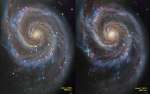 Supernovae in the Whirlpool
11.06.2011
Where do spiral galaxies keep their supernovae? Near their massive star forming regions, of course, and those regions tend to lie along sweeping blue spiral arms. Because massive stars are very short-lived, they don't have a chance to wander far from their birth place.
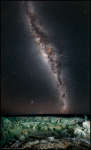 Southern Craters and Galaxies
26.12.2015
The Henbury craters in the Northern Territory, Australia, planet Earth, are the scars of an impact over 4,000 years old. When an ancient meteorite fragmented into dozens of pieces, the largest made the 180 meter diameter crater whose weathered walls and floor are lit in the foreground of this southern hemisphere nightscape.
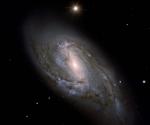 Dusty Spiral M66
2.09.2006
When morning twilight came to the Paranal Observatory in Chile, astronomers Mark Neeser and Peter Barthel interrupted their search for faint quasars, billions of light-years away. And just for a moment, they used Very Large Telescopes at the European Southern Observatory to appreciate the beauty of the nearby Universe.
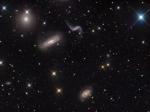 Galaxy Group Hickson 44
19.03.2007
Galaxies, like stars, frequently form groups. A group of galaxies is a system containing more than two galaxies but less than the tens or hundreds typically found in a cluster of galaxies. A most...
|
January February March April May |
|||||||||||||||||||||||||||||||||||||||||||||||||