
|
You entered: nearby
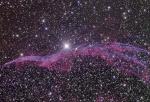 NGC 6960: The Witch's Broom Nebula
1.01.2003
Ten thousand years ago, before the dawn of recorded human history, a new light must suddenly have appeared in the night sky and faded after a few weeks. Today we know this light was an exploding star and record the colorful expanding cloud as the Veil Nebula.
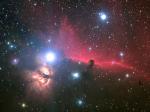 Orions Horsehead Nebula
21.03.2005
The Horsehead Nebula is one of the most famous nebulae on the sky. It is visible as the dark indentation to the red emission nebula seen above and to the right of center in the above photograph. The bright star on the left is located in the belt of the familiar constellation of Orion.
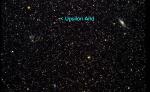 Where is Upsilon Andromedae
22.04.1999
Astronomers recently announced the detection of three large planets orbiting the star Upsilon Andromedae - the first planetary system known to orbit a normal star other than our Sun. These planets were not directly photographed but found through a Doppler technique developed to use large telescopes to search nearby stars for wobbling planetary signatures.
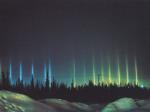 Colorful Light Pillars
5.03.2006
How can an aurora appear so near the ground? Pictured above are not aurora but nearby light pillars, a local phenomenon that can appear as a distant one. In most places on Earth...
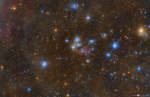 NGC 2170: Celestial Still Life
6.03.2012
Is this a painting or a photograph? In this beautiful celestial still life composed with a cosmic brush, dusty nebula NGC 2170 shines near the image center. Reflecting the light of nearby hot stars...
 Giant Galaxies in Pavo
23.06.2023
Over 500,000 light years across, NGC 6872 (top right) is a truly enormous barred spiral galaxy, at least 5 times the size of our own very large Milky Way. The appearance of this giant galaxy's distorted and stretched out spiral arms suggests the magnificent wings of a giant bird.
 NGC6366 vs 47 Ophiuchi
23.05.2025
Most globular star clusters roam the halo of our Milky Way galaxy, but globular cluster NGC 6366 lies close to the galactic plane. About 12,000 light-years away toward the constellation Ophiuchus, the cluster's starlight is dimmed and reddened by the Milky Way's interstellar dust when viewed from planet Earth.
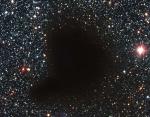 Molecular Cloud Barnard 68
23.09.2001
Where did all the stars go? What used to be considered a hole in the sky is now known to astronomers as a dark molecular cloud. Here, a high concentration of dust and molecular gas absorb practically all the visible light emitted from background stars.
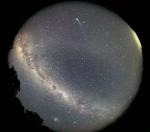 A Southern Sky View
10.03.2002
On 1996 March 22, a Galaxy and a comet shared the southern sky. They were captured together, from horizon to horizon, in the night sky above Loomberah, New South Wales, Australia by astronomer Gordon Garradd. Garradd used a home made all-sky camera with a fisheye lens, resulting in a circular 200 degree field of view.
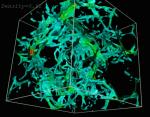 The Lyman Alpha Forest
26.01.2003
We live in a forest. Strewn throughout the universe are "trees" of hydrogen gas that absorb light from distant objects. These gas clouds leave numerous absorption lines in a distant quasar's spectra, together called the Lyman-alpha forest.
|
January February March April May |
|||||||||||||||||||||||||||||||||||||||||||||||||