
|
You entered: nearby
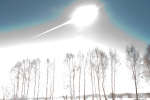 Chelyabinsk Meteor Flash
23.02.2013
A meteoroid fell to Earth on February 15, streaking some 20 to 30 kilometers above the city of Chelyabinsk, Russia at 9:20am local time. Initially traveling at about 20 kilometers per second, its explosive deceleration after impact with the lower atmosphere created a flash brighter than the Sun.
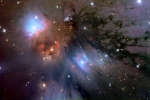 Still Life with Reflecting Dust
4.03.2017
In this beautiful celestial still life composed with a cosmic brush, dusty nebula NGC 2170 shines at the upper left. Reflecting the light of nearby hot stars, NGC 2170 is joined by other bluish reflection nebulae, a compact red emission region, and streamers of obscuring dust against a backdrop of stars.
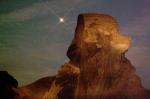 Mars Rising Behind Poodle Rock
13.08.2003
Have you seen Mars lately? As Earth and Mars near their closest approach in nearly 60,000 years on August 27, the red planet has begun to appear dramatically bright and show interesting details through telescopes and binoculars. Although not yet visible at sunset, Mars can be seen rising increasingly earlier in the evening.
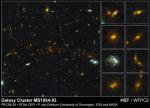 Cosmic Collisions in a Galaxy Cluster
22.07.1999
Hundreds of galaxies appear as faint smudges of light in this Hubble Space Telescope picture of galaxy cluster MS1054-03. Eight billion light-years away, the cluster is among the most distant known clusters of galaxies and is now reported to contain the largest number of colliding galaxies ever found in a cluster.
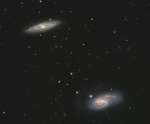 M65 and M66
15.06.2012
Nearby and bright, spiral galaxies M65 (top) and M66 stand out in this engaging cosmic snapshot. The pair are just 35 million light-years distant and around 100,000 light-years across, about the size of our own spiral Milky Way.
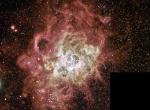 NGC 604: Giant Stellar Nursery
9.12.2003
Stars are sometimes born in the midst of chaos. About 3 million years ago in the nearby galaxy M33, a large cloud of gas spawned dense internal knots which gravitationally collapsed to form stars. NGC 604 was so large, however, it could form enough stars to make a globular cluster.
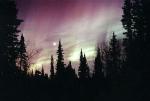 Aurora Through a Moonlit Sky
2.11.1999
A night sky can glow in fascinating ways. Through a clearing in the woods, the pictured sky above Alaska shines by reflected light from a nearby city, by the brightness of the Moon, and by aurora.
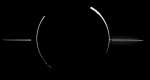 Jupiters Rings Revealed
17.06.2012
Why does Jupiter have rings? Jupiter's rings were discovered in 1979 by the passing Voyager 1 spacecraft, but their origin was a mystery. Data from the Galileo spacecraft that orbited Jupiter from 1995 to 2003 later confirmed that these rings were created by meteoroid impacts on small nearby moons.
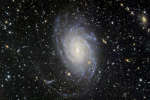 Spiral Galaxy NGC 6744
26.05.2017
Big, beautiful spiral galaxy NGC 6744 is nearly 175,000 light-years across, larger than our own Milky Way. It lies some 30 million light-years distant in the southern constellation Pavo appearing as a faint, extended object in small telescopes. We see the disk of the nearby island universe tilted towards our line of sight.
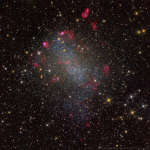 NGC 6822: Barnard s Galaxy
28.11.2020
Grand spiral galaxies often seem to get all the glory, flaunting their young, bright, blue star clusters in beautiful, symmetric spiral arms. But small galaxies form stars too, like nearby NGC 6822, also known as Barnard's Galaxy.
|
January February March April May |
|||||||||||||||||||||||||||||||||||||||||||||||||