
|
You entered: nearby
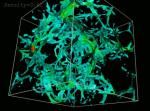 The Lyman Alpha Forest
12.11.2000
We live in a forest. Strewn throughout the universe are "trees" of hydrogen gas that absorb light from distant objects. These gas clouds leave numerous absorption lines in a distant quasar's spectra, together called the Lyman-alpha forest.
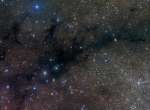 LDN 988 and Friends
24.09.2015
Stars are forming in dark, dusty molecular cloud LDN 988. Seen near picture center some 2,000 light-years distant, LDN 988 and other nearby dark nebulae were cataloged by Beverly T. Lynds in 1962 using Palomar Observatory Sky Survey plates.
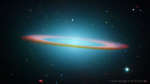 The Sombrero Galaxy in Infrared
1.01.2019
This floating ring is the size of a galaxy. In fact, it is a galaxy -- or at least part of one: the photogenic Sombrero Galaxy, one of the largest galaxies in the nearby Virgo Cluster of Galaxies.
 APOD: 2025 May 9 Б IXPE Explores a Black Hole Jet
9.05.2025
How do black holes create X-rays? Answering this long-standing question was significantly advanced recently with data taken by NASAБs IXPE satellite. X-rays cannot exit a black hole, but they can be created in the energetic environment nearby, in particular by a jet of particles moving outward.
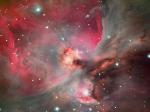 The Great Nebula in Orion
13.02.2002
Few astronomical sights excite the imagination like the nearby stellar nursery known as the Orion Nebula. The Nebula's glowing gas surrounds hot young stars at the edge of an immense interstellar molecular cloud only 1500 light-years away.
 M42: A Mosaic of Orion's Great Nebula
22.05.1999
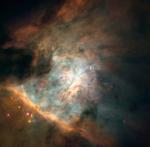
The Great Nebula in Orion, an immense, nearby starbirth region, is probably the most famous of all astronomical nebulae. Here, 15 pictures from the Hubble Space Telescope have been mosaicked to cover the inner 2.5 light years of the nebula and illustrate its diverse nature.
 Orion's Horsehead Nebula
2.10.1996
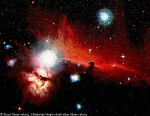
The Horsehead Nebula is arguably the most famous nebula on the sky. It is visible as the black indentation to the red emission nebula seen just to the right of center of the above photograph. The bright star near the center is located in the belt of the familiar constellation of Orion.
 M42: A Mosaic of Orion's Great Nebula
11.05.1997
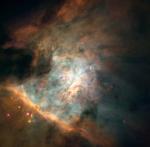
The Great Nebula in Orion, an immense, nearby starbirth region, is probably the most famous of all astronomical nebulae. Here, 15 pictures from the Hubble Space Telescope have been mosaicked to cover the inner 2.5 light years of the nebula and illustrate its diverse nature.
 Infrared Helix
1.09.1997
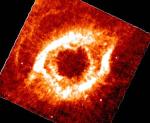
Five hundred light years from Earth, in the constellation Aquarius, a sun-like star is dying. Its last few thousand years have produced the Helix, a well studied and nearby example of a Planetary Nebula - typical of this final phase of stellar evolution.
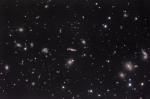 The Hercules Cluster of Galaxies
27.04.2005
These are galaxies of the Hercules Cluster, an archipelago of "island universes" a mere 650 million light-years distant. This cluster is loaded with gas and dust rich, star forming, spiral galaxies but has relatively few elliptical galaxies, which lack gas and dust and the associated newborn stars.
|
January February March April May |
|||||||||||||||||||||||||||||||||||||||||||||||||