
|
You entered: Earth
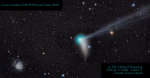 The View Toward M101
20.01.2016
Sweeping through northern skies, Comet Catalina (C/2013 US10) made its closest approach on January 17, passing about 6 light-minutes from our fair planet. Dust and ion tails clearly separated in this Earth-based view, the comet is also posed for a Messier moment, near the line-of-sight to M101, grand spiral galaxy in Ursa Major.
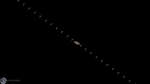 International Space Station Transits Saturn
21.01.2016
From low Earth orbit to the outer Solar System, this remarkable video frame composite follows the International Space Station's transit of Saturn. On January 15, the well-timed capture from a site near Dulmen, Germany required telescope and camera to be positioned along the predicted transit centerline, a path only 40 meters wide.
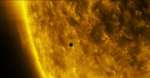 A Mercury Transit Music Video from SDO
10.05.2016
What's that small black dot moving across the Sun? Mercury. Possibly the clearest view of Mercury crossing in front of the Sun earlier this week was from Earth orbit. The Solar Dynamics Observatory obtained an uninterrupted vista recording it not only in optical light but also in bands of ultraviolet light.
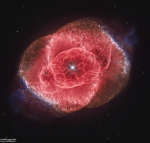 The Cats Eye Nebula from Hubble
29.01.2017
To some, it may look like a cat's eye. The alluring Cat's Eye nebula, however, lies three thousand light-years from Earth across interstellar space. A classic planetary nebula, the Cat's Eye (NGC 6543) represents a final, brief yet glorious phase in the life of a sun-like star.
 Window Seat over Hudson Bay
21.09.2018
On the August 18 night flight from San Francisco to Zurich, a window seat offered this tantalizing view when curtains of light draped a colorful glow across the sky over Hudson Bay. Constructed...
 The Seagull Nebula
18.01.2023
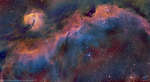
A broad expanse of glowing gas and dust presents a bird-like visage to astronomers from planet Earth, suggesting its popular moniker - The Seagull Nebula. Using narrowband image data, this 3-panel mosaic of the cosmic...
 Terran 1 Burns Methalox
5.04.2023
Relativity's Terran 1 Rocket is mostly 3D-printed. It burns a cryogenic rocket fuel composed of liquid methane and liquid oxygen (methalox). In this close-up of a Terran 1 launch on the night...
 APOD: 2023 June 11 Б The Sun and Its Missing Colors
10.06.2023
Here are all the visible colors of the Sun, produced by passing the Sun's light through a prism-like device. The spectrum was created at the McMath-Pierce Solar Observatory and shows, first off, that although our white-appearing Sun emits light of nearly every color, it appears brightest in yellow-green light.
 The Large Cloud of Magellan
6.09.2023
The 16th century Portuguese navigator Ferdinand Magellan and his crew had plenty of time to study the southern sky during the first circumnavigation of planet Earth. As a result, two fuzzy cloud-like objects easily...
 Oceans Under Jupiter's Ganymede
17.12.2000
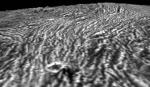
The search for extraterrestrial life came back into our own Solar System last week with the announcement that there may be liquid oceans under the surface of Jupiter's moon Ganymede. Ganymede now joins Callisto and Europa as moons of Jupiter that may harbor seas of liquid water under layers of surface ice.
|
January February March April May June July August September October |
|||||||||||||||||||||||||||||||||||||||||||||||||