
|
You entered: Earth
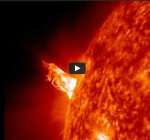 A Solar Ballet
15.01.2013
Sometimes, the Sun itself seems to dance. On just this past New Year's Eve, for example, NASA's Sun-orbiting Solar Dynamic Observatory spacecraft imaged an impressive prominence erupting from the Sun's surface. The dramatic explosion was captured in ultraviolet light in the above time lapse video covering four hours.
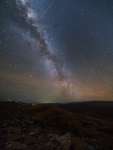 Delphinid Meteor Mystery
15.06.2013
Over a five hour period last Tuesday morning, exposures captured this tantalizing view of meteor streaks and the Milky Way in dark skies above Las Campanas Observatory in Chile. During that time, astronomers...
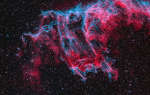 A Spectre in the Eastern Veil
29.10.2014
Frightening forms and scary faces are a mark of the Halloween season. They also haunt this cosmic close-up of the eastern Veil Nebula. The Veil Nebula itself is a large supernova remnant, the expanding debris cloud from the death explosion of a massive star.
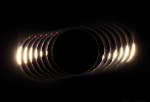 Diamond Rings and Baily s Beads
27.03.2015
Near the March 20 equinox the cold clear sky over Longyearbyen, Norway, planet Earth held an engaging sight, a total eclipse of the Sun. The New Moon's silhouette at stages just before...
 A Plutonian Landscape
18.09.2015
This shadowy landscape of majestic mountains and icy plains stretches toward the horizon of a small, distant world. It was captured from a range of about 18,000 kilometers when New Horizons looked back toward Pluto, 15 minutes after the spacecraft's closest approach on July 14.
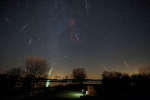 Leonids and Friends
20.11.2015
Leonid meteors rained down on planet Earth this week, the annual shower of dusty debris from the orbit of Comet 55P/Tempel-Tuttle. Leonids streak through this composite night skyview from a backyard observatory in southern Ontario.
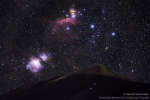 Orions Belt and Sword over Teides Peak
28.03.2016
The southern part of Orion, the famous constellation and mythical hunter, appears quite picturesque posing here over a famous volcano. Located in the Canary Islands off the northwest coast of Africa, the snow-peaked Teide is one of the largest volcanoes on Earth.
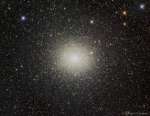 Omega Centauri: The Brightest Globular Star Cluster
27.04.2016
This huge ball of stars predates our Sun. Long before humankind evolved, before dinosaurs roamed, and even before our Earth existed, ancient globs of stars condensed and orbited a young Milky Way Galaxy. Of the 200 or so globular clusters that survive today, Omega Centauri is the largest, containing over ten million stars.
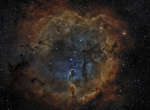 IC 1396: Emission Nebula in Cepheus
20.07.2017
Stunning emission nebula IC 1396 mixes glowing cosmic gas and dark dust clouds in the high and far off constellation of Cepheus. Energized by the bright central star seen here, this star forming region sprawls across hundreds of light-years, spanning over three degrees on the sky while nearly 3,000 light-years from planet Earth.
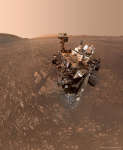 Curiosity Rover Finds a Clay Cache on Mars
29.10.2019
Why is there clay on Mars? On Earth, clay can form at the bottom of a peaceful lake when specific minerals trap water. At the pictured site on Mars, the robotic rover Curiosity drilled into two rocks and found the highest concentration of clay yet.
|
January February March April May June July August September October |
|||||||||||||||||||||||||||||||||||||||||||||||||