
|
You entered: Earth
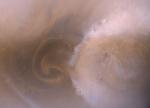 A Polar Martian Dust Storm
9.10.2000
On August 29, a large dust storm was photographed erupting out from the north polar cap of Mars. Such dust storms are not uncommon as summer advances in the north. In the above picture...
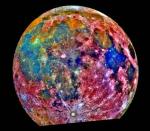 The Colorful Moon
16.03.2002
Do you recognize the Earth's Moon when you see it? The crazy, patchwork appearance of the false-color image makes this almost full view of the Moon's familiar near side look very strange.
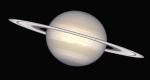 Natural Saturn On The Cassini Cruise
11.05.2002
What could you see approaching Saturn aboard an interplanetary cruise ship? Your view would likely resemble this subtly shaded image of the gorgeous ringed gas giant. Processed by the Hubble Heritage project, the picture...
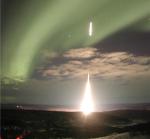 Auroral Rocket Launch
31.01.2003
In this striking image, a rocket climbs skyward toward an expansive green auroral display in the first launch of 2003 from the University of Alaska's Poker Flat Research Range. Recorded on January 27th...
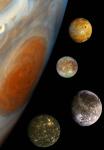 Jupiter And Family
29.09.1997
This composite image features classic portraits of members of one of the Solar System's most prominent families - Jupiter and its four large "Galilean" moons. Starting from the top the moons are Io, Europa, Ganymede, and Callisto. The top-to-bottom order is also the order of increasing distance from Jupiter.
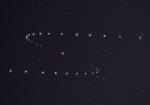 S is for Venus
7.01.2005
Planet Venus traced out this S shape in Earth's sky during 2004. Following the second planet from the Sun in a series of 29 images recorded from April 3rd through August...
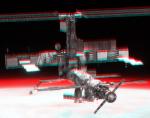 3D International Space Station
27.08.2005
Get out your red-blue glasses and float next to the International Space Station (ISS), planet Earth's largest artificial moon. This breathtaking stereo view was constructed from two separate images (S114-E-7245, S114-E-7246) recorded as the shuttle orbiter Discovery undocked from the ISS on August 6.
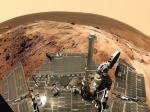 Vista Inside Gusev Crater on Mars
28.11.2005
What is the geologic history of Mars? To help find out, the robot Spirit rover explored the terrain on the way up to the top of Husband Hill and took pictures along the way.
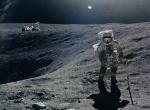 Apollo 16: Exploring Plum Crater
19.03.2000
Apollo 16 spent three days on Earth's Moon in April 1972. The fifth lunar landing mission out of six, Apollo 16 was famous for deploying and using an ultraviolet telescope as the first lunar observatory, and for collecting rocks and data on the mysterious lunar highlands. In the above picture, astronaut John W.
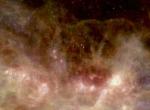 The W4 Chimney
7.02.2000
A huge chimney venting hot clouds of gas out from the plane of our Milky Way Galaxy has recently been imaged in radio waves. The Canadian Galactic Plane Survey team used an array of radio telescopes to survey an ionized gas region known as W4.
|
January February March April May June July August September October |
|||||||||||||||||||||||||||||||||||||||||||||||||