
|
You entered: stars
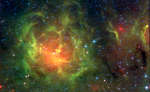 Infrared Trifid
25.07.2015
The Trifid Nebula, also known as Messier 20, is easy to find with a small telescope, a well known stop in the nebula rich constellation Sagittarius. But where visible light pictures show the nebula...
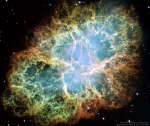 M1: The Crab Nebula from Hubble
9.09.2018
This is the mess that is left when a star explodes. The Crab Nebula, the result of a supernova seen in 1054 AD, is filled with mysterious filaments. The filaments are not only tremendously...
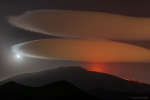 Lenticular Clouds over Mount Etna
19.08.2019
What's happening above that volcano? Although Mount Etna is seen erupting, the clouds are not related to the eruption. They are lenticular clouds formed when moist air is forced upwards near a mountain or volcano.
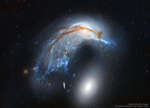 The Porpoise Galaxy from Hubble
6.02.2017
What's happening to this spiral galaxy? Just a few hundred million years ago, NGC 2936, the upper of the two large galaxies shown, was likely a normal spiral galaxy -- spinning, creating stars -- and minding its own business.
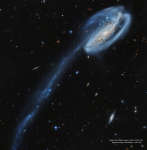 Arp 188 and the Tadpole's Tail
11.12.2018
Why does this galaxy have such a long tail? In this stunning vista, based on image data from the Hubble Legacy Archive, distant galaxies form a dramatic backdrop for disrupted spiral galaxy Arp 188, the Tadpole Galaxy. The cosmic tadpole is a mere 420 million light-years distant toward the northern constellation of the Dragon (Draco).
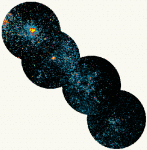 The UV SMC from UIT
20.12.1996
Translated from the "acronese" the title reads - The UltraViolet Small Magellanic Cloud from the Ultraviolet Imaging Telescope. FYI, the four ultraviolet images used in this mosaic of the nearby irregular galaxy known...
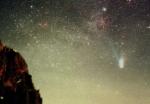 Hale-Bopp Brightest Comet This Decade
13.03.1997
The Great Comet of 1997 is now brighter than the Great Comet of 1996 ever was. In fact, it is brighter than almost every star in the sky. Yet Comet Hale-Bopp is still about two weeks away from maximum light.
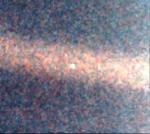 The Largest Rock Known
1.01.1998
There, that faint dot in the center - that's the largest rock known. It is larger than every known asteroid, moon, and comet nucleus. It is larger than any other rocky planet. (Nobody knows...
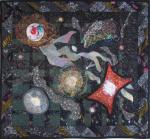 What the Hubble Saw
25.11.2004
In this striking 41 inch by 38 inch quilt, astronomy enthusiast Judy Ross has interpreted some of the Hubble Space Telescope's best galactic and extragalactic vistas. Featured in past APODs, clockwise from...
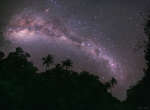 Mangaia's Milky Way
24.09.2011
From Sagittarius to Carina, the Milky Way Galaxy shines in this dark night sky above planet Earth's lush island paradise of Mangaia. Familiar to denizens of the southern hemisphere, the gorgeous skyscape includes the bulging galactic center at the upper left and bright stars Alpha and Beta Centauri just right of center.
|
January February March April May June July August September |
|||||||||||||||||||||||||||||||||||||||||||||||||