
|
You entered: stars
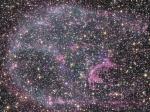 Supernova Remnant N132D in Optical and X Rays
25.10.2005
Thousands of years after a star exploded, its expanding remnant still glows brightly across the spectrum. Such is the case with N132D, a supernova remnant located in the neighboring Large Magellanic Cloud (LMC) galaxy. The expanding shell from this explosion now spans 80 light-years and has swept up about 600 Suns worth of mass.
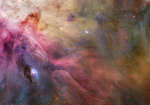 LL Ori and the Orion Nebula
3.02.2013
This esthetic close-up of cosmic clouds and stellar winds features LL Orionis, interacting with the Orion Nebula flow. Adrift in Orion's stellar nursery and still in its formative years, variable star LL Orionis produces a wind more energetic than the wind from our own middle-aged Sun.
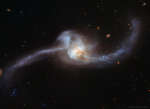 NGC 2623: Merging Galaxies from Hubble
10.01.2018
Where do stars form when galaxies collide? To help find out, astronomers imaged the nearby galaxy merger NGC 2623 in high resolution with the Hubble Space Telescope. Analysis of this and other Hubble images...
 APOD: 2025 July 16 Б The Rosette Nebula from DECam
16.07.2025
Would the Rosette Nebula by any other name look as sweet? The bland New General Catalog designation of NGC 2237 doesn't appear to diminish the appearance of this flowery emission nebula, as captured by the Dark Energy Camera (DECam) on the Blanco 4-meter telescope at the NSF's Cerro Tololo Inter-American Observatory in Chile.
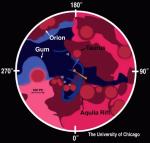 The Solar Neighborhood
25.02.1998
You are here. The orange dot in the above false-color drawing represents the current location of the Sun among local gas clouds in the spiral Milky Way Galaxy. These gas clouds are so thin that we usually see right through them. Nearly spherical bubbles surround regions of recent star formation.
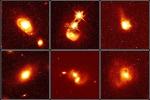 A Quasar Portrait Gallery
6.12.1997
QUASARs (QUASi-stellAR objects) lie near the edge of the observable Universe. Discovered in 1963, astronomers were astounded that such objects could be visible across billions of light-years, as this implies they must emit prodigious amounts of energy. Where does the energy come from?
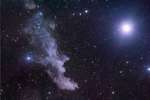 A Witch by Starlight
31.10.2008
By starlight this eerie visage shines in the dark, a crooked profile evoking its popular name, the Witch Head Nebula. In fact, this entrancing telescopic portrait gives the impression the witch has fixed her gaze on Orion's bright supergiant star Rigel.
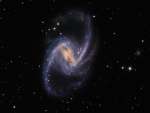 NGC 1365: Majestic Island Universe
20.08.2010
Barred spiral galaxy NGC 1365 is truly a majestic island universe some 200,000 light-years across. Located a mere 60 million light-years away toward the chemical constellation Fornax, NGC 1365 is a dominant member of the well-studied Fornax galaxy cluster.
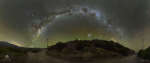 Puzzling a Sky over Argentina
26.07.2016
Can you find the comet? True, a careful eye can find thousands of stars, tens of constellations, four planets, three galaxies, and the central band of our Milky Way Galaxy -- all visible in the sky of this spectacular 180-degree panorama.
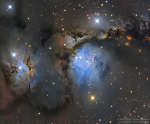 M78 and Orion Dust Reflections
24.01.2017
In the vast Orion Molecular Cloud complex, several bright blue nebulas are particularly apparent. Pictured here are two of the most prominent reflection nebulas - dust clouds lit by the reflecting light of bright embedded stars. The more famous nebula is M78, in the image center, cataloged over 200 years ago.
|
January February March April May June July August September |
|||||||||||||||||||||||||||||||||||||||||||||||||