
|
You entered: stars
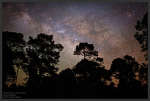 Naked Eye Nova Sagittarii 2015 No 2
24.03.2015
It quickly went from obscurity to one of the brighter stars in Sagittarius -- but it's fading. Named Nova Sagittarii 2015 No. 2, the stellar explosion is the brightest nova visible from Earth in over a year. The featured image was captured four days ago from Ranikhet in the Indian Himalayas.
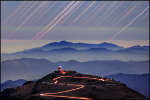 Cerro Tololo Trails
22.10.2016
Early one moonlit evening car lights left a wandering trail along the road to the Chilean Cerro Tololo Inter-American Observatory. Setting stars left the wandering trails in the sky. The serene view toward the mountainous horizon was captured in a telephoto timelapse image and video taken from nearby Cerro Pachon, home to Gemini South.
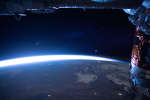 Comet NEOWISE from the ISS
10.07.2020
Rounding the Sun on July 3rd and currently headed for the outer Solar System, Comet NEOWISE (C/2020 F3) has been growing brighter in the predawn skies of planet Earth. From low Earth orbit...
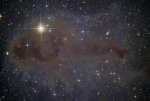 Lynds Dark Nebula
20.09.2021
Stars are forming in Lynds Dark Nebula (LDN) 1251. About 1,000 light-years away and drifting above the plane of our Milky Way galaxy, the dusty molecular cloud is part of a complex of dark nebulae mapped toward the Cepheus flare region.
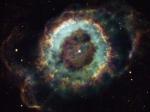 NGC 6369: The Little Ghost Nebula
8.11.2002
This pretty planetary nebula, cataloged as NGC 6369, was discovered by 18th century astronomer William Herschel as he used a telescope to explore the constellation Ophiucus. Round and planet-shaped, the nebula is also relatively faint and has acquired the popular moniker of Little Ghost Nebula.
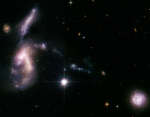 Galaxy Group Hickson 31
22.02.2010
Will the result of these galactic collisions be one big elliptical galaxy? Quite possibly, but not for another billion years. Pictured above, several of the dwarf galaxies of in the Hickson Compact Group 31 are seen slowly merging.
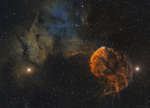 Sharpless 249 and the Jellyfish Nebula
7.03.2019
Normally faint and elusive, the Jellyfish Nebula is caught in this alluring telescopic field of view. The entire scene is a two panel mosaic constructed using narrowband image data, with emission from sulfur, hydrogen and oxygen atoms shown in red, green and blue hues.
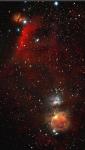 Orion Nebulosities
30.05.2002
Adrift 1,500 light-years away in one of the night sky's most recognizable constellations, the glowing Orion Nebula and the dark Horsehead Nebula are contrasting cosmic vistas. They both appear in this stunning composite color photograph along with other nebulosities as part of the giant Orion Molecular Cloud complex, itself hundreds of light-years across.
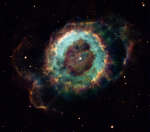 NGC 6369: The Little Ghost Nebula
28.10.2017
Wraithlike NGC 6369 is a faint apparition in night skies popularly known as the Little Ghost Nebula. It was discovered by 18th century astronomer Sir William Herschel as he used a telescope to explore the medicinal constellation Ophiucus. Herschel historically classified the round and planet-shaped nebula as a Planetary Nebula.
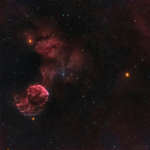 The Jellyfish and Mars
19.05.2021
Normally faint and elusive, the Jellyfish Nebula is caught in this alluring scene. In the telescopic field of view two bright yellowish stars, Mu and Eta Geminorum, stand just below and above the Jellyfish Nebula at the left. Cool red giants, they lie at the foot of the celestial twin.
|
January February March April May June July August September |
|||||||||||||||||||||||||||||||||||||||||||||||||