
|
You entered: stars
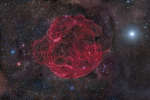 Simeis 147: Supernova Remnant
9.10.2012
It's easy to get lost following the intricate filaments in this detailed mosaic image of faint supernova remnant Simeis 147 (S147). Also cataloged as Sh2-240, it covers nearly 3 degrees or 6 full moons on the sky. That's about 150 light-years at the stellar debris cloud's estimated distance of 3,000 light-years.
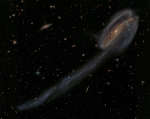 Arp 188 and the Tadpoles Tail
25.08.2014
Why does this galaxy have such a long tail? In this stunning vista, based on image data from the Hubble Legacy Archive, distant galaxies form a dramatic backdrop for disrupted spiral galaxy Arp 188, the Tadpole Galaxy. The cosmic tadpole is a mere 420 million light-years distant toward the northern constellation Draco.
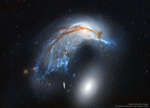 The Porpoise Galaxy from Hubble
10.05.2020
What's happening to this spiral galaxy? Just a few hundred million years ago, NGC 2936, the upper of the two large galaxies shown, was likely a normal spiral galaxy -- spinning, creating stars -- and minding its own business.
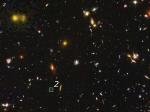 Building Galaxies in the Early Universe
10.09.2007
What was the very early universe like? To help find out, astronomers pointed the Hubble Space Telescope between bright nearby objects to create one of the deepest images ever -- the Hubble Ultra Deep Field (HUDF). The resulting HUDF is like a jewel box of strange and distant galaxies.
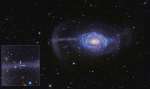 NGC 4651: The Umbrella Galaxy
2.07.2014
Spiral galaxy NGC 4651 is a mere 62 million light-years distant, toward the well-groomed northern constellation Coma Berenices. About the size of our Milky Way, this island universe is seen to have a faint umbrella-shaped structure that seems to extend (left) some 100 thousand light-years beyond the bright galactic disk.
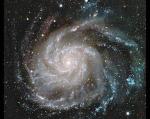 M101: The Pinwheel Galaxy
10.03.2003
Why do many galaxies appear as spirals? A striking example is M101, shown above, whose relatively close distance of about 22 million light years allow it to be studied in some detail. Recent evidence...
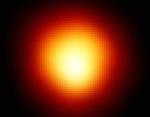 Betelgeuse
19.04.1998
Here is the first direct picture of the surface of a star other than our Sun. Taken by the Hubble Space Telescope in 1995, the atmosphere of Betelgeuse reveals some unexpected features, including a large bright hotspot visible below the center.
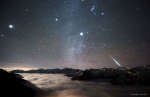 Geminid Fireball over Mount Balang
16.12.2014
This was a sky to remember. While viewing the Geminids meteor shower a few days ago, a bright fireball was captured over Mt. Balang, China with particularly picturesque surroundings. In the foreground, a sea of light clouds slowly floated between dark mountain peaks.
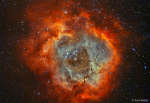 The Rosette Nebula in Hydrogen and Oxygen
24.02.2015
The Rosette Nebula is not the only cosmic cloud of gas and dust to evoke the imagery of flowers -- but it is the most famous. At the edge of a large molecular cloud...
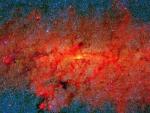 The Galactic Center Across the Infrared
5.07.2000
The center of our Galaxy is obscured in visible light by dark dust that rotates with the stars in the Galactic Plane. In this century, however, sensors have been developed that can detect light more red that humans can see - light called infrared.
|
January February March April May June July August September |
|||||||||||||||||||||||||||||||||||||||||||||||||