
|
You entered: planets
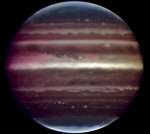 A Sharper View of a Hazy Giant
6.11.2008
This dramatic image of Jupiter is touted as the sharpest picture of the entire gas giant ever taken from the ground. The picture was made using a prototype instrument known as MAD (Multi-conjugate Adaptive optics Demonstrator) mounted on one of the European Southern Observatory's 8-meter diameter Very Large Telescope units in Chile.
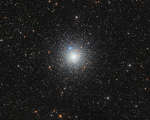 Globular Star Cluster NGC 6752
23.01.2020
Some 13,000 light-years away toward the southern constellation Pavo, the globular star cluster NGC 6752 roams the halo of our Milky Way galaxy. Over 10 billion years old, NGC 6752 follows clusters Omega Centauri and 47 Tucanae as the third brightest globular in planet Earth's night sky.
 Hale-Bopp: The Great Comet of 1997
8.04.2022
Only twenty-five years ago, Comet Hale-Bopp rounded the Sun and offered a dazzling spectacle in planet Earth's night skies. Digitized from the original astrophoto on 35mm color slide film, this classic image of the Great Comet of 1997 was recorded a few days after its perihelion passage on April 1, 1997.
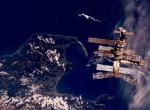 Mir Dreams
26.08.2000
This dream-like image of Mir was recorded by astronauts as the Space Shuttle Atlantis approached the Russian space station prior to docking during the STS-76 mission. Sporting spindly appendages and solar panels...
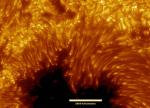 The Sharpest View of the Sun
14.11.2002
This stunning image shows remarkable and mysterious details near the dark central region of a planet-sized sunspot in one of the sharpest views ever of the surface of the Sun. Just released, the picture was made using the Swedish Solar Telescope now in its first year of operation on the Canary Island of La Palma.
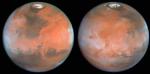 Bound For Mars
22.05.1997
Two NASA spacecraft, Mars Global Surveyor and Mars Pathfinder, are presently approaching the red planet. Pathfinder is scheduled to land on July 4th and Global Surveyor due to enter orbit in September. Recent studies...
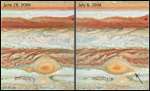 When Storms Collide
24.07.2008
These detailed Hubble Space Telescope close-ups feature Jupiter's ancient swirling storm system known as the Great Red Spot. They also follow the progress of two newer storm systems that have grown to take on a similar reddish hue: the smaller "Red Spot Jr." (bottom), and smaller still, a "baby red spot". Red Spot Jr.
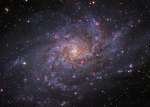 M33: Triangulum Galaxy
20.12.2012
The small, northern constellation Triangulum harbors this magnificent face-on spiral galaxy, M33. Its popular names include the Pinwheel Galaxy or just the Triangulum Galaxy. M33 is over 50,000 light-years in diameter, third largest in the Local Group of galaxies after the Andromeda Galaxy (M31), and our own Milky Way.
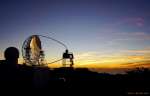 Cherenkov Telescope at Sunset
18.10.2018
On October 10, a new telescope reflected the light of the setting Sun. With dark horizon above and sunset colors below, its segmented mirror inverts an image of the beautiful evening sky in this snapshot from the Roque del Los Muchachos Observatory on the Canary Island of La Palma.
 APOD: 2024 February 12 Б HFG1 & Abell 6: Planetary Nebulae
12.02.2024
Planetary nebulae like Heckathorn-Fesen-Gull 1 (HFG1) and Abell 6 in the constellation Cassiopeia are remnants from the last phase of a medium sized star like our Sun. In spite of their shapes, planetary nebulae have nothing in common with actual planets.
|
January February March April May June July August September |
|||||||||||||||||||||||||||||||||||||||||||||||||